Affordable Multi-Use Furniture for Small Homes: A Job-by-Job Guide
Quick answer: Affordable multiuse furniture small homes can rely on starts with a list of jobs, not a list of products. Write down what each room must do, then pick pieces that cover two or three jobs without blocking the path. Favor simple mechanisms, solid frames and flat surfaces, check weight limits, and anchor anything tall to the wall with permission.
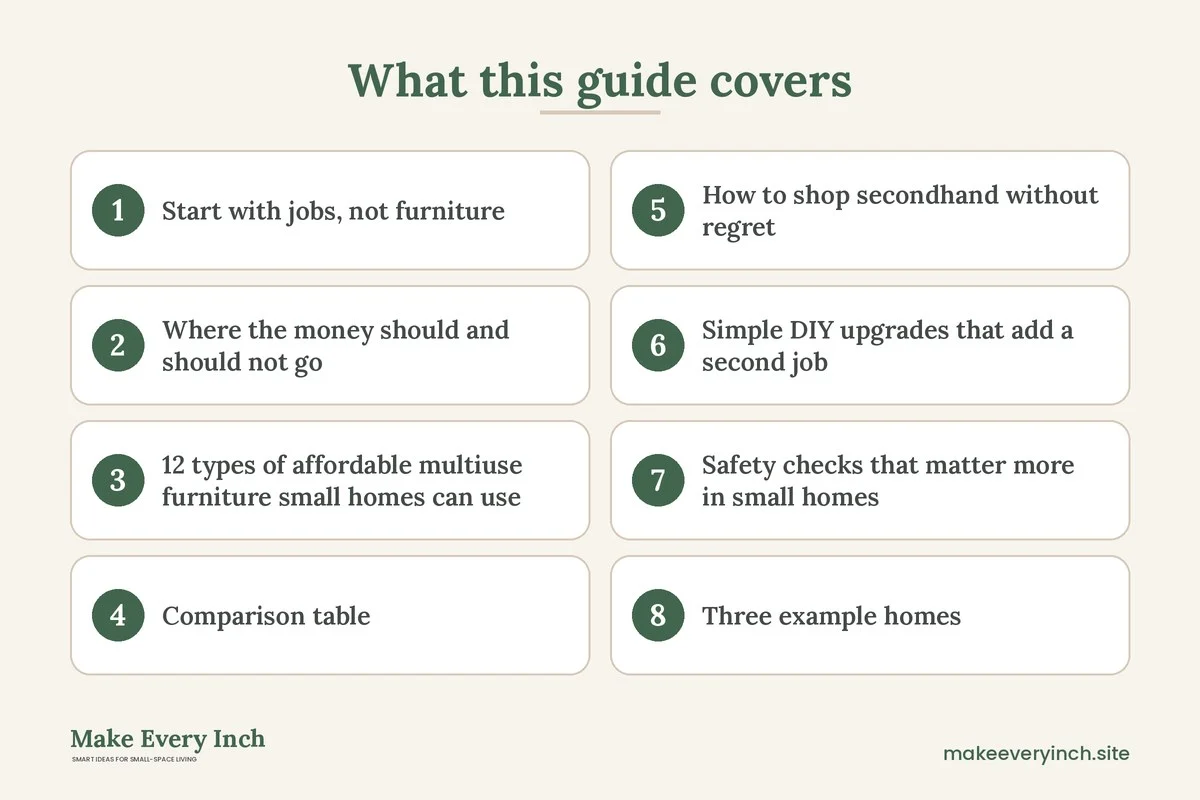
Affordable multiuse furniture small homes need is rarely the fanciest piece in the showroom. It is usually the plain bench that is also a shoe rack, the table that is also a desk, or the bed frame with drawers where a dresser used to stand. In a small home every square foot has to earn its place, and a budget makes every purchase more serious. This guide takes a job-by-job approach. You will list the jobs your home must do, rate each piece by how many of them it covers, and spend only where a hinge, a slide or a weight-bearing joint really matters. Along the way you will find 12 piece types, a comparison table, a thrift and secondhand checklist, simple DIY upgrades, three example homes, safety notes and an FAQ. For the bigger picture on saving money in a compact home, start with our pillar guide on budget small space ideas, and for related furniture thinking see small space furniture ideas that do double duty.
Start with jobs, not furniture
Most people shop by category: sofa, table, shelf. A small home works better when you shop by job. A job is something a person does or something an object needs, such as sleeping, eating, working, storing coats, seating guests or hiding a laundry basket. Write every job on a sheet of paper, one room at a time, then circle the ones that happen at different hours. Jobs that happen at different hours can share a piece of furniture. Jobs that happen at the same time cannot.
Here is an example from a one-bedroom home. Breakfast happens at 7, remote work at 9, dinner at 7 in the evening, and guests at weekends. Because breakfast, work and dinner are sequential, one table can do all three. Guests need extra seats, which can be stools that live under the table. That single decision replaces a desk, a dining table and a set of chairs with one table and two stools.
Rate each candidate piece on three questions. First, how many jobs does it cover without any setup? A bench that is a seat and a shoe shelf scores two. Second, how long does it take to switch jobs? Anything over a minute will stop being used. Third, does it still work when it is in its most closed or folded state? A fold-down table that blocks a door when open fails the third question in a narrow room.
Where the money should and should not go
A sensible budget is not spread evenly. Some parts of multiuse furniture deserve more attention than others, and some can be the cheapest option without any harm.
- Spend care on moving parts. Hinges, slides, gas lifts, folding legs and locking arms are where cheap pieces fail. Look for metal hardware that sits flush, joints that do not wobble when you push the piece, and mechanisms that stay in place when you let go.
- Spend care on weight-bearing joints. Bed frames, stools and benches carry bodies. Check the joints, the slats and the feet for sturdiness, and read the stated weight limit.
- Save on surfaces. A plain painted top, a stack of crates or a sanded board costs little and can be refinished.
- Save on storage boxes, baskets and trays. These are the add-ons that turn a plain piece into a multiuse one, and they are easy to replace.
- Save on style. A neutral, simple shape ages well and fits the next home. You can add personality with cushions, paint and hardware later.
Another honest rule: the cheapest option is the piece you do not need to replace. A wobbly folding table that collapses in a year costs more than a solid secondhand one that lasts a decade. Because prices vary so much by region and season, this guide does not quote any; compare options in your own area and judge by construction, not just by the number on the tag.
12 types of affordable multiuse furniture small homes can use
Seating that works double or triple
1. A storage bench
A bench with a lift-up lid or an open shelf below seats guests, holds shoes or blankets, and works as a low table at the end of a bed. It suits entryways, bedroom ends and dining sides. Keep the lid light so a child cannot be trapped, and choose a lid that stays open or has a soft-close hinge. Our guide to small entryway bench ideas shows how to place one.
2. A lidded storage ottoman
An ottoman is a footrest, extra seat, tray table and blanket store in one. Look for a firm, flat top, a lid that does not slam, and sides that do not sag under weight. For specific features to compare, read our list of the best ottomans with storage for small homes.
3. Stackable or folding stools
Stools hide under a table or inside a closet and appear for guests. Stackable ones save floor space, and folding ones save even more. Check that the legs lock and the seat does not twist.
4. A sofa with a second life
A sofa that converts to a bed saves a room in a studio or a guest corner. A simpler approach is a firm sofa with a long, deep seat that works for lounging, with a folding mattress topper stored in a closet for visitors. Because a sofa is used every day, prioritize comfort over the extra feature.
Tables and work surfaces
5. A drop-leaf or gateleg table
The leaves fold down when you want floor space and rise for dinner or work. A narrow one against a wall can be a console on a normal day. For more on tables that adapt, see the best small dining tables.
6. A nesting set
Two or three tables that slide into each other act as a coffee table, side tables and a laptop stand. They are one of the least expensive ways to gain flexible surface. Take a look at the best nesting tables for small apartments for details on sizes.
7. A wall-mounted fold-down desk
A shelf-like panel that folds up when unused creates a desk without a permanent footprint. Wall mounting needs permission in a rental and proper fixings into studs or suitable anchors. If drilling is not allowed, a freestanding folding table that leans in a closet gives a similar result. Read about small space ideas with fold-down furniture for layouts.
Beds and storage
8. A bed with storage underneath
Drawers or a lift-up base turn dead space into storage for off-season clothes and bedding. Check that the drawers glide and that the lift mechanism holds the base steady. If a frame is out of reach, raise your current one on sturdy risers and slide flat bins underneath. Compare options in the best storage beds for small bedrooms.
9. A wall bed or fold-up bed
This is the biggest space-saver, but also the biggest commitment. A wall bed must be anchored to the structure by a qualified person and is not suitable for most rentals. If you are curious, our guide to the best Murphy beds for small homes explains what is involved.
10. A bookcase that is also a room divider
A low, open bookcase placed perpendicular to a wall marks a zone, stores books and holds a plant. Back it with a plain panel or leave it open to let light through. Because it is tall, it must be anchored to the wall or kept low enough to be stable, especially with children or pets around.
Hidden helpers
11. A cabinet with a flip-up top
A slim cabinet that hides a folding table or ironing board behind its door does two jobs without ever showing the second one. It suits entryways and hallways, and it keeps the item off the floor.
12. A rolling cart
A cart is a bar, a bathroom caddy, a craft station and a bedside table. Locking wheels are important so the cart stays put when you reach for something. Choose one with a rim around each shelf.
Comparison table: which piece covers which job
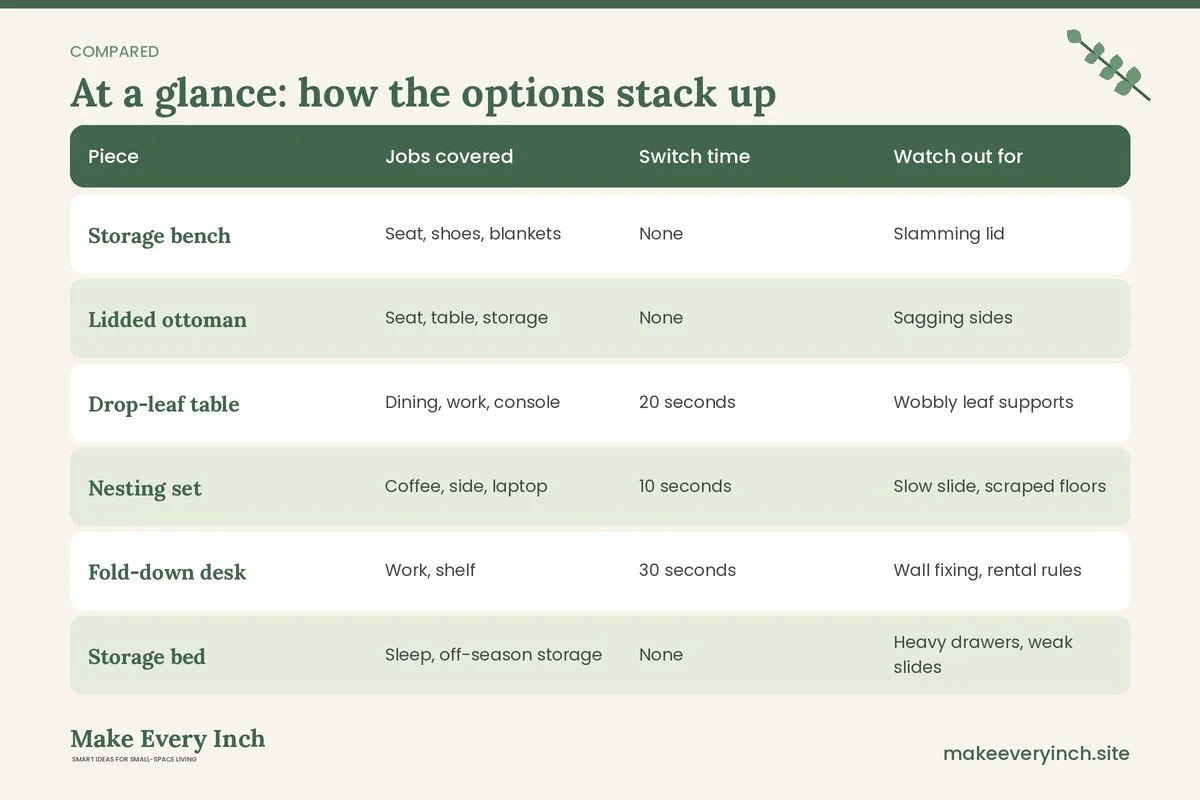
The table below shows how common pieces stack up. Treat the ratings as general guidance, not exact measurements, and use your own job list to decide.
| Piece | Jobs covered | Switch time | Watch out for |
|---|---|---|---|
| Storage bench | Seat, shoes, blankets | None | Slamming lid |
| Lidded ottoman | Seat, table, storage | None | Sagging sides |
| Drop-leaf table | Dining, work, console | 20 seconds | Wobbly leaf supports |
| Nesting set | Coffee, side, laptop | 10 seconds | Slow slide, scraped floors |
| Fold-down desk | Work, shelf | 30 seconds | Wall fixing, rental rules |
| Storage bed | Sleep, off-season storage | None | Heavy drawers, weak slides |
| Open bookcase divider | Storage, zoning | None | Tipping risk |
| Rolling cart | Bar, bath, bedside | None | Unlocked wheels |
| Stackable stools | Seat, plant stand, step | 5 seconds | Stability, step use |
How to shop secondhand without regret
Secondhand is where many affordable multiuse pieces live, because solid older furniture tends to be well built and simple. A quick inspection prevents most disappointments.
- Wobble test. Push the piece from several angles. A little movement can be fixed with a screw or glue, but a piece that twists at the joints is likely to get worse.
- Mechanism test. Open and close every hinge, drawer and leaf several times. They should move smoothly and stay where you put them.
- Smell test. A musty or smoky smell can linger in upholstery and untreated wood. Airing helps, but a very strong smell is a reason to walk away.
- Pest check. Inspect seams, crevices and the underside of upholstered pieces for signs of insects. For beds and sofas, take extra care.
- Measure twice. Measure the doorway, the stairs and the elevator in addition to the room. A piece that fits the room but not the entry is useless.
- Check for recalls and safety standards on older items. Cribs, bunks and anything used by small children are best purchased new or from a source that can confirm their safety status.
- Ask about the finish. Older paint may contain materials you do not want in a home with children. If you plan to sand or strip a piece, learn the safe method for your area first.
Simple DIY upgrades that add a second job
You do not need advanced skills to make a piece more useful. These upgrades use basic tools and can be done in a weekend.
Add a shelf under a table
A thin board resting on two cleats under a console or desk creates a lower shelf for baskets. Use screws into the table legs only if you own the piece. For a rental or a borrowed table, use a ready-made under-table organizer that clips on, and stay within its stated weight limit.
Put casters on a stool or cart
Locking casters turn a plain stool or crate stack into a moving unit. Choose casters rated for more than the load, and use locking ones so the piece does not roll when someone leans on it.
Cover a crate stack with a board
Two or three sturdy crates and a smooth board make a bench, a coffee table or a desk. Fix the board to the crates with screws or non-slip pads so it cannot slide. Sand the edges and use a low-VOC finish if you paint or seal the wood, and ventilate the room while it dries.
Add hooks, rails and clips
A rail on the side of a cabinet or the back of a door gives a coat, bag or tool a place to hang. In a rental, adhesive hooks that match the weight of the item are an option; follow the manufacturer’s weight limit and test a hidden spot first. See our guide to DIY wall storage ideas for small spaces for more ideas.
Make a lid softer
A strip of felt or a soft-close stay on a storage bench lid protects fingers. For anything a child might use, this is worth doing.
Safety checks that matter more in small homes
When furniture moves, folds and stores things, a few safety points deserve a deliberate pause.
- Anchor tall pieces. Bookcases, wardrobes and tall cabinets should be fixed to the wall with the right hardware for the wall type. In a rental, ask the landlord for permission first; never drill without it. If you cannot anchor, keep furniture short and low, and avoid placing heavy items on high shelves.
- Respect weight limits. Every shelf, stool, bed slat and wall fixing has a limit. If a piece will be used as a seat and a table, assume the heavier use.
- Mind fingers and hinges. Lift-up lids and fold-down tops can pinch. Choose soft-close hardware or add stays, especially around children.
- Keep exits clear. Never block a door, window or fire exit with a fold-out bed or a divider.
- Electrical and heat. Do not push furniture over power strips or bury cords. Keep storage away from radiators and heaters, and never cover a vent. Use a surge-protected outlet and keep cords visible and tidy.
- Wet areas. Furniture near a sink or tub needs a moisture-resistant finish. Keep outlets in wet areas protected by a GFCI, and do not place a plug-in item where it can get splashed.
- Ventilation. Fresh paint and glue release fumes. Choose low-VOC products and open a window while you work.
- Children and pets. Make sure lids do not trap, drawers have stops, and cords are out of reach. Do not let children climb on shelves or stools that were not designed as steps.
Three example homes
A studio for one person
The resident needs to sleep, work, eat and have occasional guests. A bed with drawers underneath handles bedding and off-season clothes. A drop-leaf table by the window serves as a desk by day and a dining table at night, with two stackable stools that slide under it. A storage ottoman at the foot of the bed holds a spare throw and acts as a seat when a friend visits. A narrow rolling cart beside the bed doubles as a nightstand and a kitchen helper. The jobs are sequenced, so the room never needs more than one of each tool at a time. For more on this layout, see the studio apartment furniture ideas.
A one-bedroom for a couple who work from home
The couple needs two work surfaces, a place to eat and a calm bedroom. They place a long, narrow table against the living room wall so both can work side by side, and keep a nesting pair beside the sofa for the evening. When dinner arrives, they clear the table and pull out two stools from under it. In the bedroom, an open bookcase doubles as a divider for a corner desk, anchored with permission. Because they both need quiet at times, one of them sets up in the bedroom corner while the other uses the table. See how to fit a desk into a studio apartment for further layout ideas.
A two-bedroom for a small family
Children need play space, storage and a place to do homework, while the parents want to stay sane. A storage bench in the entryway holds shoes and school bags. A rolling cart in the kids’ room moves from craft table to snack station. A sturdy table in the living area is the dining table, homework desk and board game surface, with the bench pulled up to it on one side. Low storage cubes under a window serve as seats, toy store and window bench in one. The family’s main rule is that every piece must be movable by one adult, so the room can change from a play space to a dining space in minutes. For family-specific dining ideas, our sibling post on small space dining furniture for families goes into more detail.
A weekend plan to put this into practice
You do not have to replace everything at once. A staged approach spreads the effort and lets you learn from each step.
- Saturday morning: list the jobs room by room and mark the ones that happen at different times.
- Saturday afternoon: measure the walkways, doors and the largest empty wall. Mark the footprint of each candidate piece with painter’s tape on the floor.
- Sunday morning: go through what you already own. A box, a crate, a bench or a stool may already be a good candidate for a second job.
- Sunday afternoon: write a short shopping list of no more than three items, in order of how many jobs each covers. Live with the change for two weeks before adding anything else.
Common mistakes to avoid
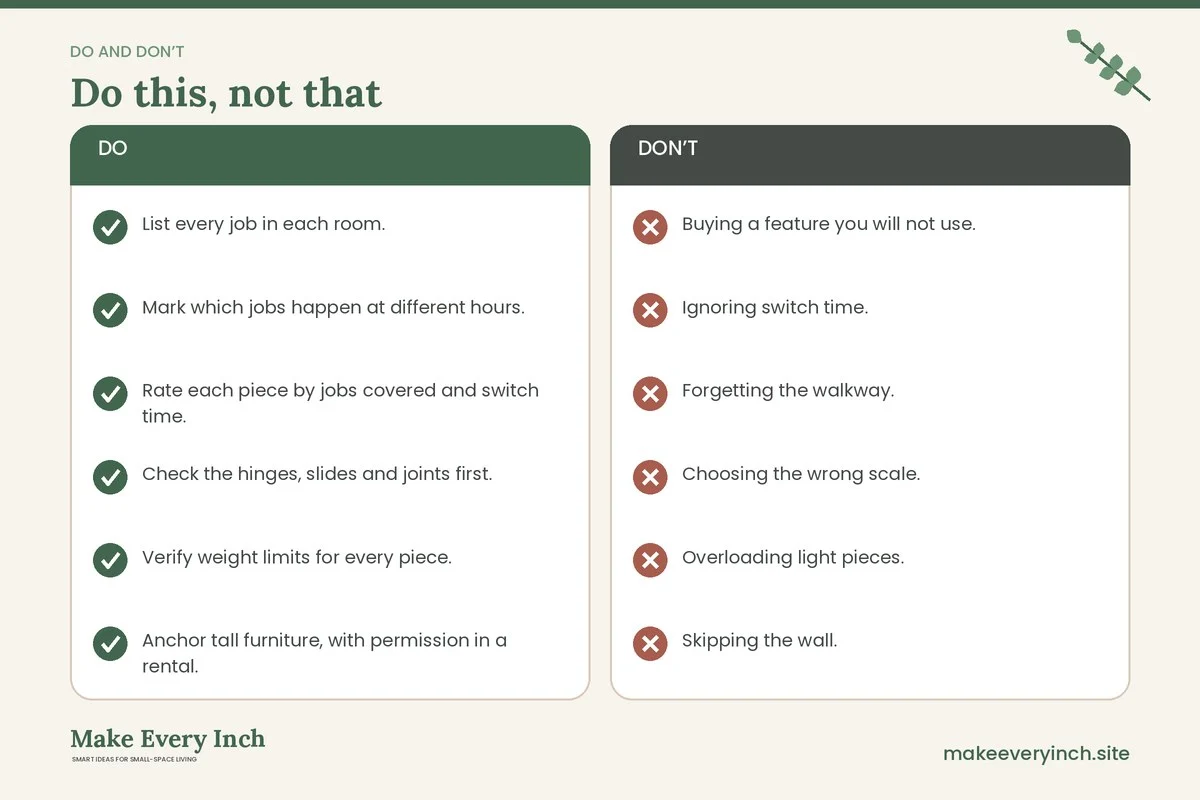
- Buying a feature you will not use. A fold-out bed that you set up twice a year is not a multiuse piece for daily life.
- Ignoring switch time. If it takes ten minutes to convert a piece, you will leave it in one form.
- Forgetting the walkway. A table that is perfect when open can trap you when it is. Test with tape first.
- Choosing the wrong scale. Oversized pieces crowd the room, while too-small pieces force you to buy more later.
- Overloading light pieces. A lightweight cart or shelf is not a heavy-duty storage unit. Respect the limits.
- Skipping the wall. Vertical space is free. Use wall-mounted shelves where allowed, and consider wall-mounted furniture ideas for small homes when you can.
- Chasing a matching set. Mixed pieces in the same color family look more collected and let you buy over time.
Quick checklist
- List every job in each room.
- Mark which jobs happen at different hours.
- Rate each piece by jobs covered and switch time.
- Check the hinges, slides and joints first.
- Verify weight limits for every piece.
- Anchor tall furniture, with permission in a rental.
- Keep a 30 inch main walkway where you can.
- Choose low-VOC finishes and ventilate when painting.
- Keep cords tidy and vents uncovered.
- Add soft-close hardware around children.
- Measure doorways and elevators before buying.
- Buy no more than three items at a time.
FAQ
What is the most useful multiuse piece for a tiny home?
A table that can serve as a desk, a dining spot and a console is usually the most flexible, followed by a storage bench or ottoman. Your own job list decides.
Is secondhand furniture a good choice?
Often, yes. Older pieces can be solid, but inspect joints, hinges and surfaces, and measure the entrance before you buy.
Can I make multiuse furniture myself?
Simple upgrades such as casters, shelves and board-topped crates are manageable. For anything that carries weight or folds, follow the proper fixing methods, and use a professional for wall beds.
How do I avoid damaging a rental?
Choose freestanding pieces, use felt pads, and ask for written permission before you drill or mount anything. See our guide to renter friendly apartment decorating ideas.
How do I keep multiuse furniture safe around children?
Use soft-close lids, drawer stops and anchored tall pieces, and keep cords and small parts out of reach.
How many multiuse pieces are too many?
If you spend more time converting furniture than using it, you have gone too far. Aim for a few pieces that switch in under a minute.
Keep going: Keep going with our guides to furniture that makes small rooms feel bigger, budget friendly furniture ideas for small apartments and thrifted furniture ideas for small homes.
Save this guide for later
Pin the ideas you like to Pinterest so you can come back to them when you plan your space.