14 Small Living Room Ideas for Renters for Couples on a Shared Lease
Quick answer: The best small living room ideas for renters for couples treat the lease as a shared document: agree who pays for what, keep every purchase removable and labeled by owner, and give each person a seat, a surface and a storage spot. Use a sofa 68 to 80 inches long, keep a 30 to 36 inch walkway, choose freestanding furniture over anything that needs holes, and photograph the room together at move-in.
Small living room ideas for renters for couples have a problem that single renters do not: two people, two sets of belongings, one lease and often one deposit. The room has to work as a place where both of you relax, host, work and store things, and it has to be undone cleanly when the lease ends or when one of you moves out. That last part is rarely discussed, and it matters whether you are partners, newly married, long-term roommates or two friends splitting rent. This guide takes the style and audience angle: how to set up house rules, how to read the lease together, who owns what, how to share a small room of perhaps 9 to 12 feet wide and how to keep the whole setup removable. It includes a shared-lease table, 14 ideas, three example rooms, a routine for the week, a move-out plan and a checklist. For the full overview, read our guide to small living room ideas for renters, our pillar on small living room ideas and the companion post on small living room furniture ideas for couples.
Read the lease together, in one sitting
Most couples skim the lease separately, and each person assumes the other has checked the details. Sit down together and read the sections that affect a living room: alterations, nails and adhesives, paint, flooring protection, noise, guests, and the clause on joint liability. Joint liability matters most. On many leases, every named tenant is responsible for the whole rent and for damage, so a mark that one of you makes is a problem for both. Check what your own agreement says, and if the wording is unclear, ask the landlord or property manager to clarify in writing.
Write down three things in a shared note. First, what the lease allows without asking, such as small nail holes, adhesive strips or removable hooks. Second, what needs written permission. Third, what is banned. Keep this note with the lease. It stops arguments later, because the answer to “can we hang that?” is already on paper.
If one person is on the lease and the other is not, the situation changes. The named tenant carries the legal responsibility, so they may reasonably want the final say on anything that touches the walls or floors. Agree on this early and kindly. If you are roommates rather than partners, the same logic applies, and it helps to have a short written agreement about shared items.
Decide who owns what before you buy anything
Furniture disputes are common when a couple or a pair of roommates splits up, moves out or moves on to a bigger place. A little structure now saves a lot of trouble later. Use one of three simple systems.
- Ownership by purchase: whoever pays owns the item, and the receipt goes in a shared folder.
- Shared fund: each person puts a monthly amount into a joint account used for shared pieces. The pieces are owned jointly, and a rule decides who keeps what if you part.
- Split by category: one person supplies the sofa and rug, the other supplies lamps, tables and storage. This is easy to remember and to separate.
Whichever you choose, put a small sticker or a note on the underside of items you own individually, and keep a simple list with a rough value for each. The list also helps with renter’s insurance, since you need to know what is in the room to claim for it.
Talk about what happens to the shared things at the end. If you leave the place together, who keeps the sofa you bought together? A sentence in the shared note such as “the sofa goes to whoever is staying” makes the future less awkward.
Measurements for a two-person room
A living room for two has to seat two comfortably, hold two sets of belongings and allow two people to move through at once. These are the measurements to check in a room 9 to 12 feet wide.
- Sofa length: 68 to 80 inches seats two people without crowding. In a room 9 feet wide, avoid sofas over 84 inches.
- Sofa depth: 30 to 36 inches. Deeper sofas feel luxurious but eat into the floor.
- Main walkway: 30 to 36 inches, wide enough that two people can pass without turning sideways.
- Space between sofa and TV: at least 6 to 7 feet.
- Side table distance: 16 to 24 inches from the seat edge, so each person can reach a drink.
- Space beside a chair: 12 to 16 inches between the end of the sofa and a chair so one person can pass the other.
- Rug: about 5 by 8 feet, with at least the front legs of the sofa and chair on it.
- Desk or table depth: 20 to 24 inches for a shared laptop spot, or 30 inches if two people will sit across from each other.
Tape these out on the floor with painter’s tape before you commit, and try the room as a couple. Walk through it at the same time, carry a laundry basket or a tray, and sit down together. If one person has to wait for the other, the plan needs more clearance.
A note on tall furniture. Bookcases, tall shelving and wardrobes can tip. When you share a home, you may also share it with children, visitors or pets, so anchor tall pieces to the wall with the maker’s hardware where the lease allows. If it does not, request permission in writing, choose a shorter and heavier unit, put heavy items on the lower shelves and keep tall pieces away from beds, sofas and doorways. Never rely on a tall unit staying upright just because it is full.
14 small living room ideas for renters for couples
Seating that serves two people
1. A loveseat plus one chair
In a room 10 feet wide, a 70 to 76 inch loveseat and a slim armchair give each person a seat and let one stretch out. Keep 12 to 16 inches between them, and angle the chair a little toward the sofa so you can talk. Because the pieces are separate, they are easy to divide or move later. For good small sofa features, see our list of best sofas for small apartments.
2. A sofa with removable legs and covers
Choose a sofa whose legs unscrew and whose covers are washable. Removable legs help it fit through a narrow door, and covers handle the wear that comes with two people using it daily. This also lets one person take it later without a struggle.
3. A sectional only if you have the width
A compact L-shaped sofa can work for couples who like to lie together, but it needs a room at least 10 by 12 feet. Our guide to small living room ideas with a sectional shows layouts that fit, and the list of best sectionals for small living rooms covers shapes. In a rental, check that a modular version can be split into pieces for moving.
4. Floor seating for guests
Two poufs or floor cushions that tuck beneath a console give you extra seats when friends visit. They store out of sight, and neither person has to give up their usual spot. When guests leave, the floor is clear again.
Surfaces and storage without holes
5. A matched pair of side tables
One table at each end of the sofa gives each person a drink spot and a place to charge a phone. Keep the tops 14 to 16 inches wide, and choose a small lip so glasses stay put. A pair is also easy to divide, since each person can take one.
6. A shared console with his and hers baskets
A console table of 10 to 14 inches deep behind the sofa or against a wall makes a drop zone. Give each person a basket for keys, wallets, mail and chargers, and label them. Everything lands in the right basket, and the surface stays clear. See our post on small living room storage ideas for couples for more ways to split storage.
7. A freestanding bookcase, anchored if allowed
Vertical storage matters when two collections of books, games and chargers share one room. Choose a unit that is 10 to 12 inches deep and place heavy items low. Anchor it if the lease allows. Our guides to best narrow bookshelves and renter-friendly shelving show options that avoid drilling.
8. An ottoman with storage
A storage ottoman holds blankets, game controllers and spare chargers, and it serves as a table or a footrest. If you share it, split the interior with a small bin for each person. Our list of best storage ottomans covers features to check.
Zones for different habits
9. A work corner that folds away
If one of you works from home, a folding table or a wall-leaning desk of about 24 inches deep gives a spot for a laptop. Choose one that folds flat to 2 or 3 inches so the room returns to a living space in the evening. For ideas, see our guide to best desks for small apartments.
10. A reading nook for the other person
Pair a small armchair with a floor lamp and a side table to create a corner where one person can read while the other watches TV. A rug under the chair marks the nook. Use headphones or a screen that can be angled so the two activities do not clash.
11. A TV setup that does not need holes
If the lease bans wall mounts, use a slim stand or a console of 14 to 16 inches deep. Keep the screen center at about 40 to 44 inches from the floor when seated. Our guide to small living room TV wall ideas and the post on renter-friendly TV wall ideas offer setups that avoid drilling.
Removable style that suits both of you
12. A shared palette with room for two tastes
Agree on a base of two or three colors for the large items, such as the sofa, rug and curtains. Then let each person choose accents, such as a lamp, a throw or a print. The base keeps the room calm, and the accents show both personalities. If tastes differ widely, a neutral base with one bold item each avoids a standoff.
13. Lighting you can split and take
Plug-in lamps and bulbs that you own can be taken at move-out and swapped with the landlord’s fixtures. Put a lamp at each end of the sofa so each of you has a dimmer side. See our guide to renter-friendly lighting ideas and small living room lighting ideas for more.
14. A removable gallery wall
Use adhesive strips rated for the frame weight, or lean frames on a console. Let each person pick several pieces, mixing travel photos, prints and shared favorites. Test the strips in a hidden spot first. Our post on renter-friendly wall decor ideas has methods for different wall types.
Shared-lease table: decisions to make together
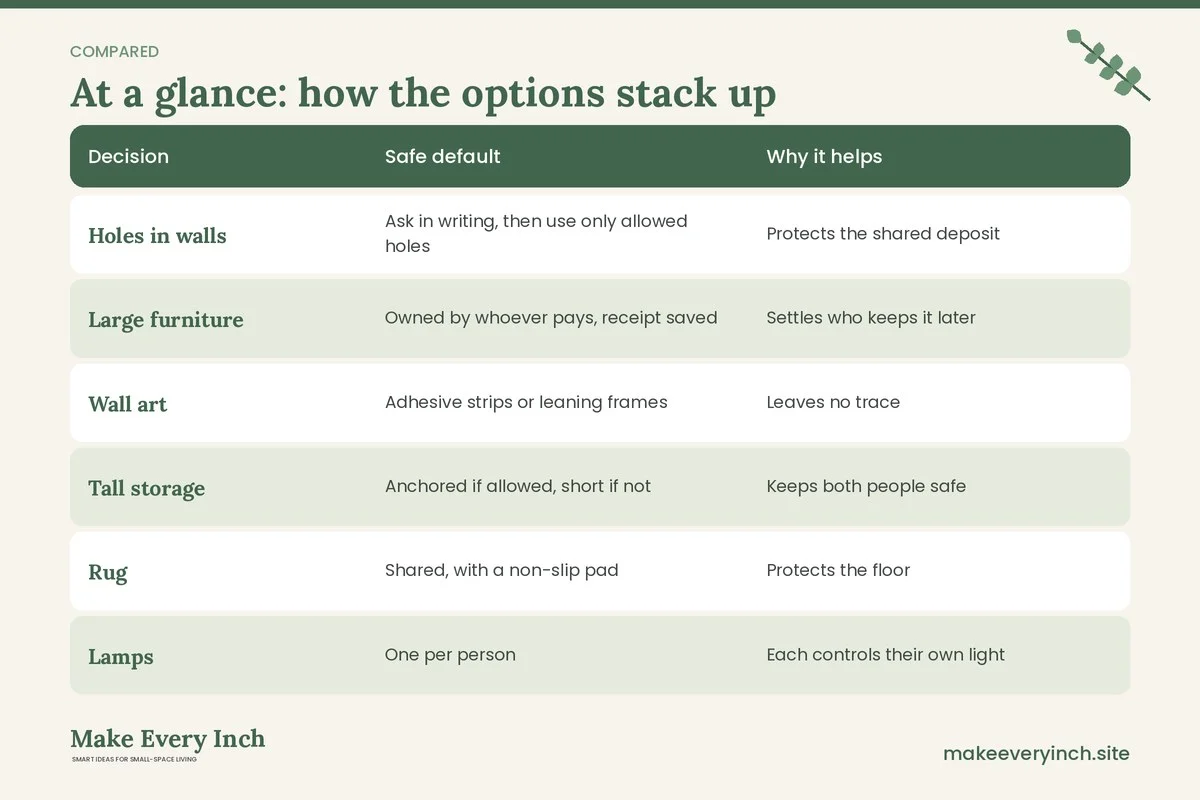
This table pairs common couple decisions with a safe default for renters. Use it to agree before you buy, not after.
| Decision | Safe default | Why it helps |
|---|---|---|
| Holes in walls | Ask in writing, then use only allowed holes | Protects the shared deposit |
| Large furniture | Owned by whoever pays, receipt saved | Settles who keeps it later |
| Wall art | Adhesive strips or leaning frames | Leaves no trace |
| Tall storage | Anchored if allowed, short if not | Keeps both people safe |
| Rug | Shared, with a non-slip pad | Protects the floor |
| Lamps | One per person | Each controls their own light |
| Electronics | Owned by the original buyer | Avoids disputes |
| Move-out photos | Taken together on the same day | Gives joint proof of condition |
Three example rooms for couples
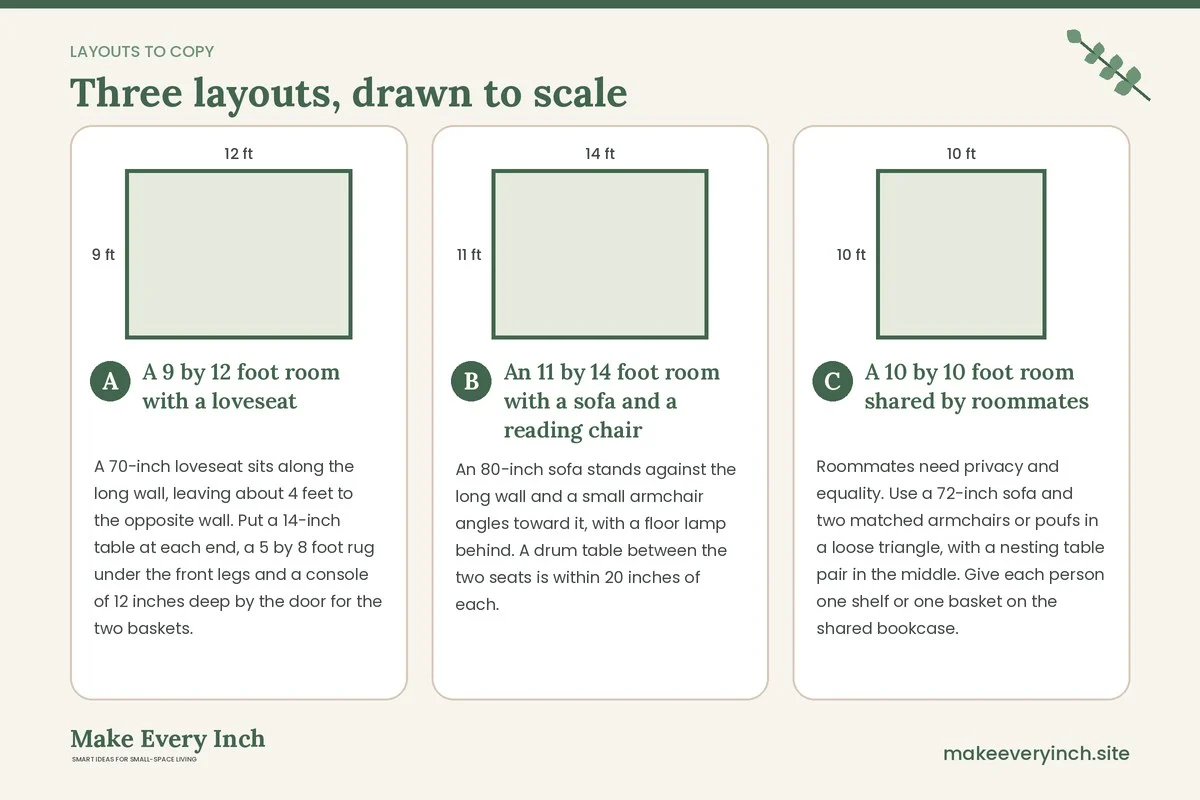
A 9 by 12 foot room with a loveseat
A 70-inch loveseat sits along the long wall, leaving about 4 feet to the opposite wall. Put a 14-inch table at each end, a 5 by 8 foot rug under the front legs and a console of 12 inches deep by the door for the two baskets. The walkway is a clear 34 inches. A slim bookcase of 10 inches deep stands on the short wall, anchored if possible. This plan suits partners who mostly relax in the room and host occasionally.
An 11 by 14 foot room with a sofa and a reading chair
An 80-inch sofa stands against the long wall and a small armchair angles toward it, with a floor lamp behind. A drum table between the two seats is within 20 inches of each. A folding desk leans against the short wall for the person who works at home. The TV sits on a 15-inch stand opposite the sofa, 8 feet away. The room supports two activities at once, and each piece is freestanding.
A 10 by 10 foot room shared by roommates
Roommates need privacy and equality. Use a 72-inch sofa and two matched armchairs or poufs in a loose triangle, with a nesting table pair in the middle. Give each person one shelf or one basket on the shared bookcase. Hang or lean a mirror opposite the window. Keep a 30-inch path to the kitchen. No one’s belongings dominate, and nothing is fixed to the wall.
A weekly rhythm that keeps a shared room tidy
Small rooms stay pleasant when two people share the work. A few habits keep arguments away.
- A nightly five-minute reset: each person clears their own surface and returns cups to the kitchen.
- One basket per person: everything personal goes in the basket and leaves the room by Sunday.
- A weekly wipe: surfaces, remotes and the floor under the rug edges once a week.
- A monthly swap: rotate pillows, throws or prints so both tastes get a turn.
- A guest rule: tell each other before inviting friends over, so the room can be cleared.
- A quiet hours note: if one person works from home, agree on times when the TV is low.
These small rules cost nothing, and they matter more than any piece of furniture.
Noise, privacy and time alone
A shared living room is also a shared sound space. In an apartment, hard floors and thin walls carry noise to neighbors, and a rug helps. Felt pads under furniture legs reduce scraping. If you work from home, a folding screen can mark off a corner for calls. A screen is freestanding, easy to fold and easy to take with you.
Time alone matters too. A small room can feel crowded when both people are in it all day. A reading nook, headphones and a clear schedule of when each person has the room give both a break. If you are roommates, a simple note about who has the room on which evenings reduces friction.
Moving out together, or apart
Plan the end before the start. At move-out, walk through the room together with your move-in photographs. Remove adhesive strips slowly, wipe residue, fill allowed holes and put back any hardware you swapped. Then photograph the room from the same angles, and keep the images with the lease.
If you separate or one person leaves, the shared-lease note and the furniture list make the split easy. Whoever keeps an item pays the other their share, or the item goes to the person named in your note. Agree on a notice period and on how to handle a deposit if only one of you leaves the lease. Put it in writing, even if you are close.
Mistakes couples and roommates make
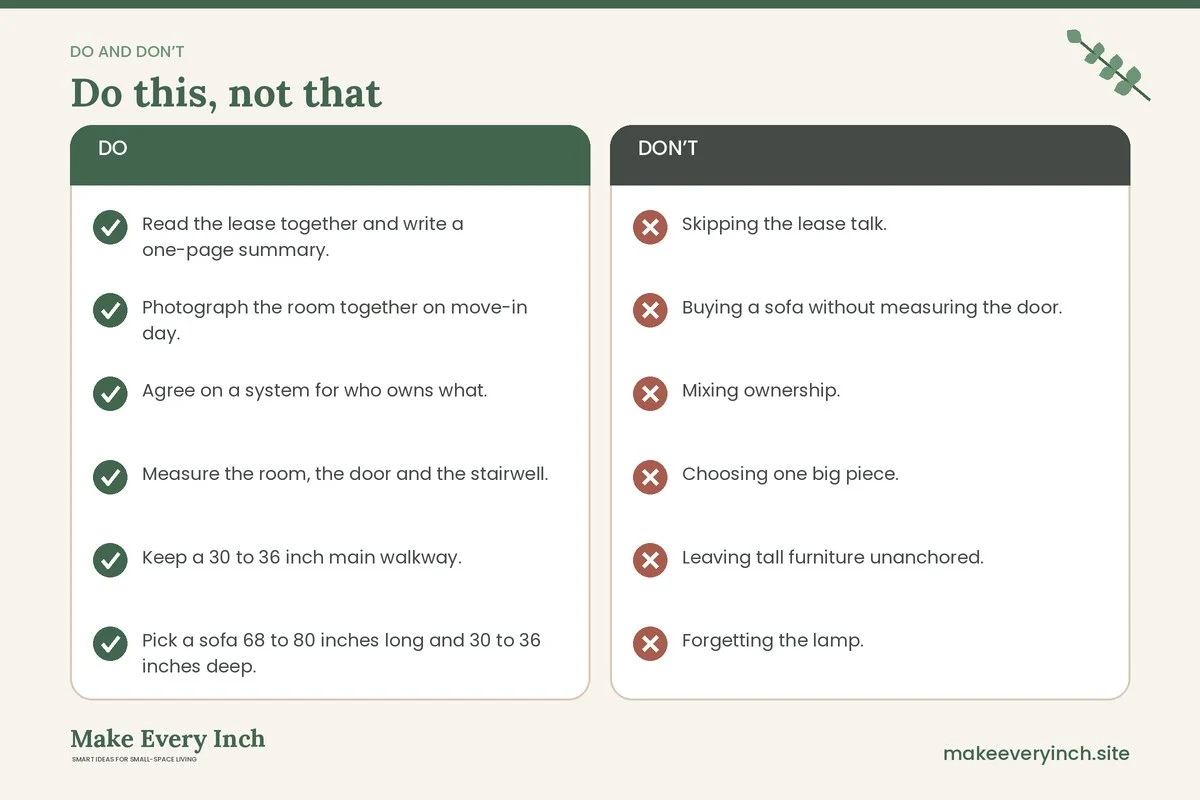
- Skipping the lease talk. Two people each assume the other checked it.
- Buying a sofa without measuring the door. Two returns are twice as annoying.
- Mixing ownership. Without a list, every item becomes a negotiation.
- Choosing one big piece. A sofa that dominates the room leaves little for the second person’s needs.
- Leaving tall furniture unanchored. If it can fall, anchor it or choose a safer unit.
- Forgetting the lamp. A dark corner makes a small room feel smaller.
- Ignoring the exit plan. The best time to decide who keeps the sofa is before you buy it.
Couples renter checklist
- Read the lease together and write a one-page summary.
- Photograph the room together on move-in day.
- Agree on a system for who owns what.
- Measure the room, the door and the stairwell.
- Keep a 30 to 36 inch main walkway.
- Pick a sofa 68 to 80 inches long and 30 to 36 inches deep.
- Give each person a seat, a surface and a basket.
- Add a lamp at each end of the sofa.
- Anchor tall furniture where the lease allows.
- Test adhesive strips in a hidden spot.
- Agree on a weekly reset and on guest rules.
- Plan the move-out day and the split in advance.
FAQ
Who is responsible for damage in a shared rental?
It depends on the lease, but many agreements make every named tenant jointly responsible. Read the clause on liability, and if it is unclear, ask the landlord or property manager to explain it in writing.
What if one of us is not on the lease?
The named tenant carries the responsibility, so they may reasonably decide what touches the walls and floors. Agree on this openly, and keep a written note of any shared rules.
How do we split furniture costs fairly?
Common methods are ownership by whoever pays, a shared fund or a split by category. Save receipts in a shared folder and keep a list with rough values.
What is the best sofa size for two people in a small rental?
A sofa of 68 to 80 inches long and 30 to 36 inches deep seats two comfortably in a room 9 to 12 feet wide while leaving a 30 to 36 inch walkway.
Can we hang art without damaging the walls?
Often yes, with adhesive strips rated for the frame, leaning frames on a console or a tension rod. Check the lease and test in a hidden spot first. See our guide to no-drill storage ideas for renters for more options.
Should we anchor a bookcase in a rental?
Where the lease allows, yes. If it does not, ask in writing or choose a shorter, heavier unit and keep it away from seating and sleeping areas.
Keep going: Keep planning with our small living room ideas for renters, cozy small living room ideas for couples and renter-friendly apartment decorating ideas.
Save this guide for later
Pin the ideas you like to Pinterest so you can come back to them when you plan your space.