12 Small Space Styling Rules for Open Shelves
Quick answer: The core small space styling rules open shelves need are: leave about a third of each shelf empty, group items in odd numbers, mix heights with the tallest toward one side, repeat two or three colors, put heavy and useful things low, and anchor every tall unit to the wall. Keep 2 to 3 inches of air above objects, and edit the shelves every season.
Small space styling rules open shelves can follow are easier to learn than most people think. Open shelves are the most exposed decor in a small home. They sit at eye level, they never close, and everything on them is judged at once. That is why a shelf that looks charming in a photo can look chaotic in a studio, and why a few clear rules matter more here than in a spacious house with plenty of other things to look at. This guide gives you 12 rules with measurements, a repeatable shelf formula, a comparison of what to put where, three example shelves, a weekly reset, and the safety steps for anchoring and weight. If you want the wider picture of decorating a compact home, begin with our pillar guide on small room decor ideas.
What open shelves do in a small space
An open shelf does two jobs at once. It stores things, and it decorates the wall. In a small room, that double role is a benefit, because a shelf can replace a cabinet, a console and a gallery wall in one footprint. But it is also the reason open shelves go wrong. If you treat a shelf only as storage, it looks like a stockroom. If you treat it only as display, it holds nothing useful and you end up with a second storage spot elsewhere.
The best approach is to decide each shelf’s job before you place anything. A shelf near the entry might be 70 percent practical, with keys, a bowl and a basket. A shelf above a desk might be 70 percent work tools. A shelf by the sofa might be mostly display, with books, a plant and a lamp. Once the job is clear, the styling rules become simple to apply, because you are arranging for a purpose and not guessing.
Open shelves also change how a room feels. A solid wall of shelves can crowd a narrow space, while a few shelves with open gaps feel airy. Keep depth in mind. A shelf that is 8 to 10 inches deep holds books and small objects without jutting out, while a 12 inch deep shelf suits baskets but takes more room. In a hallway or a narrow room, shallower is usually better. For storage furniture ideas, see our guide on best narrow bookshelves.
The shelf formula: thirds, threes and a hero
Most good shelf styling can be reduced to a short formula that you can repeat on every shelf. Use it as a starting point, then adjust to taste.
- Thirds of space. About one third of each shelf holds a main group, one third holds a smaller group or a single object, and one third stays empty. The empty third is not wasted. It is what lets the other two read clearly.
- Odd numbers. Groups of three or five look composed. Pairs can look stiff unless they are deliberate bookends.
- A hero. Give each shelf or each unit one hero object, such as a framed print, a sculptural vase or a handsome lamp. The remaining items support it and are lower or smaller.
Start from the top and work down, or start from the middle shelf and work out, but whichever you choose, step back after each shelf and look at the whole unit. A shelf that is balanced on its own can still compete with its neighbor, so check the whole wall every few minutes.
12 small space styling rules for open shelves
Rules about space
1. Leave a third of every shelf empty
Empty space is part of the design. A shelf filled edge to edge reads as a storage rack, while a shelf with breathing room reads as a display. Count the length of the shelf, and make sure at least a third has nothing on it.
2. Keep 2 to 3 inches of air above objects
Leave a gap between the top of the tallest object and the shelf above. Objects pressed against the next shelf look cramped and are hard to reach. If a shelf is adjustable, move it so the air gap is about 2 to 3 inches over the tallest item.
3. Do not fill every shelf
In a unit with five shelves, let one or two be almost bare, or leave a cube open. A unit that is evenly full on every level has no focal point and looks like a wall of stuff.
Rules about grouping
4. Group in odd numbers
Three objects of different heights make a stronger cluster than two or four. Place the tallest at the back or to one side, the middle one slightly forward, and the smallest in front.
5. Use the triangle shape
Arrange a cluster so the tops of the objects form a loose triangle. The eye moves smoothly down from the tallest piece, and the cluster looks stable.
6. Stack and stand books both ways
Use some books upright and some stacked flat. Upright rows give the shelf rhythm, while a flat stack makes a base for a small object. Keep stacks to two or three books, and put the largest on the bottom. Turn the spines the same way for neatness.
Rules about color and material
7. Repeat two or three colors
Choose a palette and echo it across the unit. If the room uses warm white, wood and a muted green, let the shelves carry those same three. Spines of mixed colors can be turned inward, covered or grouped by tone to calm the shelf. Our guide on small dining room color schemes shows how a narrow palette can tidy a busy room.
8. Mix materials, but limit them
A shelf looks richer when it mixes wood, ceramic, metal and fabric, but too many textures look busy. Pick two or three materials and spread them across the shelves.
9. Hide the ugly with baskets and boxes
Chargers, papers and small tools look untidy on display. Put them in baskets, lidded boxes or fabric bins. Choose the same material and tone for all of them, and label the fronts for yourself so you can find things quickly. See our post on small space organization ideas for more on containers.
Rules about weight and placement
10. Put heavy things low
Place the heaviest objects on the bottom shelves, and keep the top shelves light. A top-heavy unit is more likely to tip, and heavy things are easier to lift from a lower height. Follow the weight rating of each shelf, which is usually printed in the instructions, and do not exceed it.
11. Keep useful things between knee and shoulder height
Everything you use daily should sit between about 24 and 60 inches from the floor, where you can reach it without a stool or a stoop. Display items can go higher or lower. A shelf full of items you need to reach on tiptoe turns into a clutter spot because nobody returns things to it.
12. Edit with the seasons
Every three months, take everything off, wipe the shelves, and put back only what still belongs. Open shelves go stale and collect dust and extras quickly, so a regular edit is part of the style, not an extra. Rotate a few objects from a storage box to keep the display fresh.
Safety first: anchoring, weight and drilling
Open shelves involve weight, height and wall fixings, so a few safety steps are not optional.
- Anchor tall units. Any bookcase or shelving unit that is taller than it is wide, or taller than about 30 to 36 inches, should be anchored to the wall with the anti-tip hardware that comes with it or hardware rated for the unit. Tall furniture can tip, particularly if children climb it or if the top is loaded with heavy items.
- Never drill without permission. If you rent, read the lease and ask your landlord in writing before drilling. If you cannot drill, choose freestanding units, ladder shelves that lean with the right stability, or tension-based systems, and see our guide on renter-friendly shelving ideas without drilling and our overview of renter-friendly shelving.
- Use the right fixings. Wall type matters. Studs, drywall, plaster and masonry each need different anchors. Check the weight rating of the anchor, not just the shelf, and keep a safety margin well above the load you expect.
- Do not rely on adhesive for heavy loads. Adhesive strips and hooks have strict weight limits and can fail under books, ceramic or glass. Use them only for light items, and only within the printed rating.
- Keep heavy and breakable things low. If a shelf is above a bed, sofa or desk, store only light, soft items on it, and avoid glass, heavy frames and sharp objects overhead.
- Mind cords and lamps. If a shelf holds a lamp or lights, check the bulb’s maximum wattage, keep the bulb away from paper and fabric, and avoid overloading the outlet. Route cords so they do not hang where they can be pulled or tripped on, and see our post on renter-friendly ways to hide cords.
- Check plants. Some common houseplants are toxic to cats and dogs, so check each plant and place it where a pet cannot chew it. Put pots on saucers so water does not damage the shelf.
What goes where: a shelf comparison
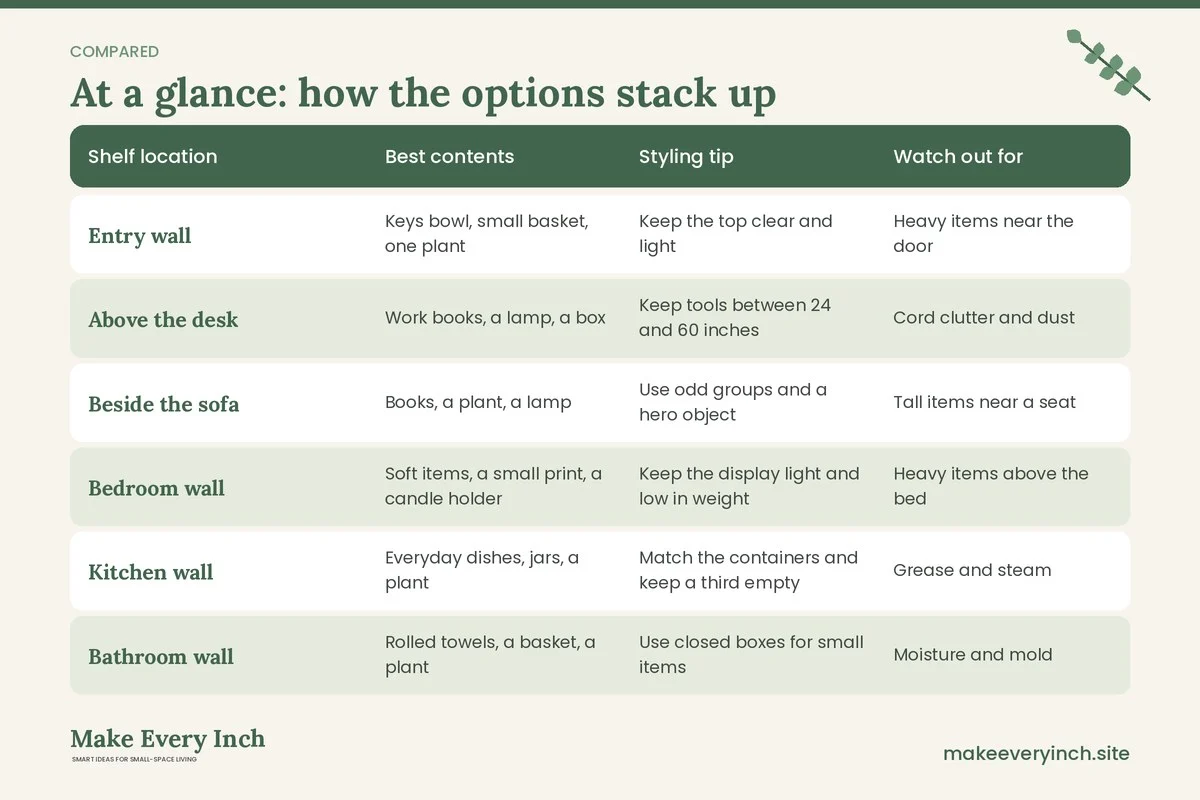
The table below compares common shelf locations and what usually works best on each. Use it to decide the job of a shelf before you style it.
| Shelf location | Best contents | Styling tip | Watch out for |
|---|---|---|---|
| Entry wall | Keys bowl, small basket, one plant | Keep the top clear and light | Heavy items near the door |
| Above the desk | Work books, a lamp, a box | Keep tools between 24 and 60 inches | Cord clutter and dust |
| Beside the sofa | Books, a plant, a lamp | Use odd groups and a hero object | Tall items near a seat |
| Bedroom wall | Soft items, a small print, a candle holder | Keep the display light and low in weight | Heavy items above the bed |
| Kitchen wall | Everyday dishes, jars, a plant | Match the containers and keep a third empty | Grease and steam |
| Bathroom wall | Rolled towels, a basket, a plant | Use closed boxes for small items | Moisture and mold |
| Hallway ledge | Art, frames, one lamp | Keep it shallow so it does not jut out | Narrow walkways and bumps |
Three example shelves
A five-shelf bookcase in a living room
This 30 inch wide unit sits next to the sofa. The bottom shelf holds two baskets of throws and games, because heavy and bulky items belong low. The next shelf holds the books you read most, with about a third of the width left empty and a small plant at one end. The middle shelf is the hero shelf, with a framed print leaning at the back, a vase on one side and a short stack of books. The upper shelves hold light display pieces and a few empty cubes. A lamp sits on the table beside it, not on the unit, to spare the cords. The unit is anchored to the wall. For living room planning, take a look at our guide on small living room ideas.
A pair of floating shelves in a kitchen
Two shelves, 24 inches wide, hold everyday items. The lower shelf has four matching mugs on one side and a plant on the other, with a third of the length empty between them. The upper shelf holds a row of matching jars for pasta and grains, and a short stack of plates. The jars are in the same material, so the display looks planned. Cooking grease coats open shelves, so everything is wiped monthly. The shelves must be fixed to studs or the right anchors, and in a rental you should get permission, or use a freestanding rack instead. Our guide on small kitchen ideas has more on kitchen storage.
A narrow shelf above a studio bed
A single 36 inch shelf above a bed is tempting, but it needs strict limits. Keep the load very light: a small frame, a folded scarf in a basket and a battery candle, nothing glass or heavy. Leave half the shelf empty. If you cannot fix it securely, skip it, and use a lamp and a print on the wall instead. Our post on studio apartment decorating ideas offers other ways to decorate this area.
A five-minute weekly reset
A shelf only looks good if you maintain it. Spend five minutes a week on a short routine.
- Take away anything that does not belong, such as mail, cups and chargers.
- Straighten the stacks and lines.
- Wipe the front edge of each shelf where dust shows first.
- Check that nothing is sitting too close to a lamp bulb.
- Make sure the empty third is still empty.
A once-a-season edit is the deeper version. Take everything off, wash the objects, vacuum the shelves, and put back about 70 percent of what was there. The leftover items go to the storage box, to a friend or to donation.
Common shelf mistakes
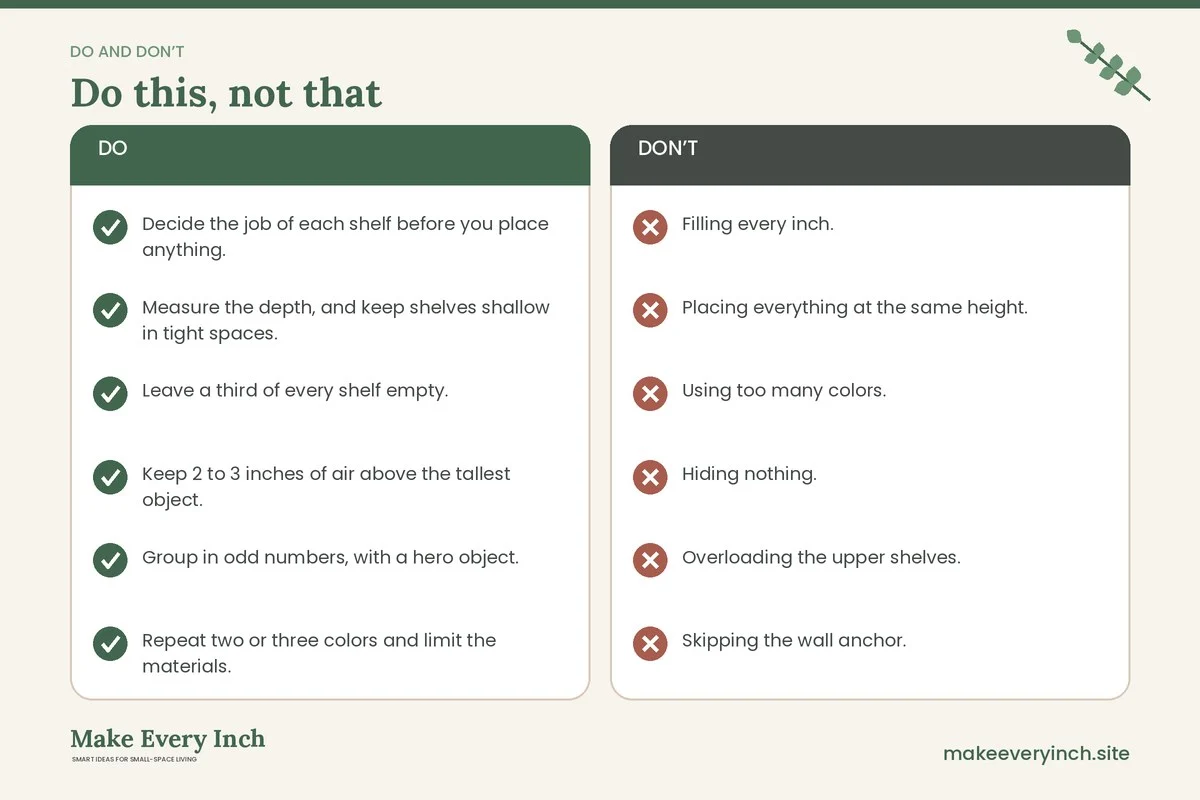
- Filling every inch. A full shelf looks like storage, even when it holds beautiful things.
- Placing everything at the same height. A flat row lacks rhythm, so add a few tall pieces and a few low ones.
- Using too many colors. A palette of five or more makes the shelf look noisy.
- Hiding nothing. Open shelves do not mean everything must be visible. Use boxes for the ugly items.
- Overloading the upper shelves. Heavy items high up are a tipping and falling hazard.
- Skipping the wall anchor. A tall unit that is not anchored is a hazard, even when it looks stable.
- Ignoring dust. Open shelves collect dust quickly, and busy displays make it harder to clean. Fewer items mean easier cleaning.
Budget approach
Open shelves do not need expensive items. Start with what you own: books you love, ceramics, a plant and a few frames. Add baskets and boxes in a single material to hide the practical items. Second-hand shops and online marketplaces often have simple vases, trays and frames. Spray or paint mismatched items in a single color to unify them, using a low-VOC paint, ventilation and a protected surface. For more low-cost ideas, read our guide on budget small space ideas and our post about apartment decorating styles, which can help you choose a direction. To cut down on items before you style, our guide on renter-friendly wall decor ideas shows what can go on the wall instead.
Checklist
- Decide the job of each shelf before you place anything.
- Measure the depth, and keep shelves shallow in tight spaces.
- Leave a third of every shelf empty.
- Keep 2 to 3 inches of air above the tallest object.
- Group in odd numbers, with a hero object.
- Repeat two or three colors and limit the materials.
- Put heavy items low and light items high.
- Keep daily items between about 24 and 60 inches.
- Hide the practical clutter in baskets or boxes.
- Anchor tall units, and get permission before drilling.
- Check shelf and anchor weight ratings, with a safety margin.
- Check lamp wattage labels and tidy the cords.
- Check plants for pet safety.
- Reset weekly, and edit every season.
FAQ
How full should an open shelf be?
Aim to leave about a third of each shelf empty. If it looks crowded, remove items until each object can be seen on its own.
What is the easiest way to style a bookshelf in a small room?
Use the formula of thirds, odd groups and a hero object. Mix upright and stacked books, add a plant, and tuck the practical items into baskets.
How do I stop open shelves from looking messy?
Use matching containers, limit your colors, keep a third empty and do a quick reset each week. Fewer items always look tidier.
Do I need to anchor a bookcase?
Yes, for any tall unit. Use the anti-tip hardware supplied or hardware rated for the unit, and fix it to a stud or the right wall anchor. Tall, loaded furniture can tip, particularly around children and pets.
Can I put shelves above a bed?
Only with great care. Use very light items, fix the shelf securely with fixings rated for the load, and avoid glass and heavy objects. If you cannot be sure, choose a safer arrangement.
What can I do if I cannot drill in a rental?
Ask your landlord for permission first. If it is refused, use freestanding shelves with anti-tip straps that do not need drilling into the wall surface, or other options in our guide to renter-friendly shelving.
Keep going: Keep going with our pillar on small room decor ideas, the sibling guide to small room decor ideas that avoid clutter and our post on renter-friendly lighting ideas.
Save this guide for later
Pin the ideas you like to Pinterest so you can come back to them when you plan your space.