Small Laundry Room Ideas: The Complete Guide to Washing Well in Little Space
Quick answer: The best small laundry room ideas start with the machines and the safety clearances, then build upward. Measure the washer, dryer, doors and hose or vent routes first, use the wall space above the machines for shelves and rods, give every supply a labeled home, plan a drying spot that does not block the walkway, light the area well and keep the dryer vent and lint trap clean. Check the lease before you drill and have a qualified professional handle gas, venting and electrical work.
Small laundry room ideas all start from the same awkward fact: the chore is constant, yet the space it gets is often the smallest and least loved in the home. The washer sits in a closet, a corner of the kitchen or a gap beside the bathtub, and the detergent, baskets and drying racks spill into every room around it. The good news is that a tidy laundry zone needs far less floor than most people think. A stacked pair of machines can fit in a footprint of roughly two feet by three feet, and the wall above and around them can carry nearly everything else. This pillar guide pulls together everything we know about doing laundry well in a small home. It covers how to plan the space, where it can live, storage, drying, work surfaces, lighting, safety, budget fixes and rental rules. Each section links to a detailed guide, and the final section lists every small laundry post in one place. If you rent, keep your lease in mind throughout.
Start with how you actually do laundry
Before you buy a single basket or shelf, spend two weeks noticing how laundry really flows through your home. How many loads do you run each week? Do you wash everything together or sort by color, fabric and wash temperature? Do you use a dryer all year, or do you air dry delicates and towels? Do you iron, fold on a surface or fold straight from the basket? A single person who runs one load a week needs a very different space from a family that washes most days.
Write a short list of what the space must support and rank it. A common list includes a washer, a dryer or a drying rack, a hamper, a shelf for detergent, a spot for a lint bin and somewhere to fold. Add anything unusual, such as a delicates bag, a steamer, a mop and bucket or a stack of cleaning supplies. The ranked list tells you how much storage you need, and it stops you from buying a cabinet that is too large for the room. If your needs are modest, our guide to small laundry area ideas for apartments shows setups that work in almost any rental.
Next, measure. Draw the space on graph paper, and mark the machines, the door swing, the water supply and drain, the dryer vent, the outlets and any radiator or boiler. Measure the machines with their doors open, because a front-loading door can need 20 inches or more of clear floor in front. Tape the footprint of the basket and your standing space on the floor with painter’s tape and live with the tape for a day. Tape costs nothing and prevents most expensive mistakes. For a longer walk-through of the planning stage, see our post on small laundry room organization.
Choose the spot: where a small laundry can live
The best location is usually the one that already has water, a drain and, for a dryer, a safe way to vent. Moving plumbing and venting is expensive and often needs a licensed professional, so most small homes keep the laundry where the connections are. The question becomes how to make that spot work harder. Work through the common options below and weigh them against your home. None is perfect, and each has trade-offs that the linked guides explain in detail.
An apartment nook
Apartments often hide the washer in a hall niche, behind bifold doors or in a corner of a bedroom hallway. The challenge is that there is rarely any wall you are allowed to change. Over-the-door racks, freestanding shelves, stackable bins and slim rolling carts do most of the work. See our guide to small laundry area ideas for apartments for plans that keep the space tidy without drilling.
A closet
A laundry closet is a neat solution because doors hide the machines and the mess. It also limits airflow, light and reach. A dryer needs air to work properly, so the door often needs vents or louvers, and nothing should be stored against the dryer or in the exhaust path. Read laundry closet organization ideas before you start, and see our wider pillar on small closet ideas for ways to free up the space around it.
A utility closet
Some homes pair the laundry with the water heater, the furnace or the breaker panel. In that case the space has to stay clear for access and safety. Our guide to small utility closet organization ideas explains how to store supplies without blocking the equipment or the panel.
A kitchen
Plenty of small homes tuck a washer under a counter or beside the fridge. That makes sense for plumbing, but it puts detergent near food and humidity near cabinets. See laundry room ideas in a kitchen for ways to hide the machine and keep supplies separate, and our pillar on small kitchen ideas for the wider room.
A bathroom
A washer in the bathroom is common in older and compact homes. The main concerns are moisture, electrical safety near water and keeping towels and detergent dry. Our post on laundry room ideas in a bathroom goes through shelves, hampers and ventilation, and the hub on small bathroom ideas covers the rest of the room.
A narrow space
A hallway or a slim alcove can hold a compact laundry if you plan the width carefully. Allow enough room to open the door, load the machine and still walk past. See small laundry room ideas for narrow spaces for layouts that keep the path clear.
An older home
Older homes may have odd corners, low ceilings, basements or untested wiring. Upgrades there need extra care. Our guide to small laundry room ideas for older homes explains how to work with what you have and when to call a professional.
Layout: arrange the room around the machines
A good layout is mostly about clearances. Leave the space the manufacturer’s instructions recommend around each machine, because many appliances need a gap at the back and sides for hoses, vents and airflow. Keep at least 30 inches of clear floor in front of a front-loader so you can open the door and crouch to load it. If two people use the room, leave room for both to pass. Keep the walkway free of baskets, because a loaded basket on the floor is a tripping risk.
Think in zones. A dirty zone is where clothes arrive, a wash zone holds the machines, a dry zone holds the dryer or rack, and a fold zone gives you a flat surface. In a small space these zones overlap, so the trick is to move through them in a line. Clothes in a hamper on one side, machines in the middle and a fold surface and shelf on the other side make an easy flow. Put items you use every wash, such as detergent, at waist or chest height. Put items you use monthly, such as stain removers or spare filters, high up or low down.
If you have a choice, stack the machines. A stacked washer and dryer, where the model allows it, frees floor space for a basket or a narrow cart. Always follow the manufacturer’s rules about stacking, and use the correct kit. Our guide to stacked washer dryer storage ideas shows how to use the sides and the top without blocking vents or controls.
Storage: make the walls and the gaps work
A small laundry stays calm only if everything has a home. The rule of thumb is to store vertically, keep the machine tops as clear as safety allows and put things you use every wash within reach. Daily items include detergent, softener and a stain stick. Weekly items can go in a bin or a basket. Monthly or seasonal items, such as machine cleaner and spare lint screens, can go in a labeled box elsewhere.
- Wall shelves above the machines hold detergent, baskets and folded towels without taking floor space.
- A tension rod between two walls gives a hanging spot for drip-dry items.
- A slim rolling cart slides into the gap beside the machine and holds bottles and cloths.
- Over-the-door organizers hold small items such as lint rollers, dryer sheets and clothespins.
- Lidded bins hide mismatched bottles and give the room a calmer look.
- Clip-on or magnetic holders use the side of the machine for light items, if the side is steel and the manufacturer allows it.
Our guides to small laundry room storage ideas and small laundry room shelf ideas cover these options in detail, and the pillar on small space organization ideas shows general systems you can borrow.
Supplies: fewer, better, labeled
Most laundry clutter is bottles and boxes. Cut the number of products you keep. One detergent, one softener if you use it, one stain remover and one fabric-safe bleach alternative cover most homes. Decant bulk powder into a lidded container only if the original label and safety instructions stay visible, and keep all laundry chemicals out of reach of children and pets. Never mix cleaning products, and especially never mix bleach with ammonia or acids, because the fumes are dangerous. For a system you can copy, see how to organize laundry supplies in a small home.
Families and busy homes
A household with children makes a lot of laundry and a lot of small socks. Give each person a bin or a labeled basket, run a weekly sorting routine and keep one small bin for odd socks. Our post on small laundry room organization for families shows how to make the system simple enough that everyone uses it.
Drying: where wet clothes go
Drying is the hardest part of laundry in a small home. A dryer is quick, but it needs venting, power or gas and regular cleaning. Air drying saves energy, but it needs a place for damp fabric and good airflow. Many households use both, with the dryer for towels and bedding and a rack for delicates.
Choose a rack that suits the space. A folding rack stands in a bathtub or a corner and folds flat afterward. A wall-mounted rack swings out and tucks back. A ceiling-mounted pulley rack lifts clothes out of the way. A tension rod over the tub or a door-hung rail turns dead space into a drip zone. Whichever you use, leave room around the clothes so air can move, and run a fan or open a window to avoid damp. Wet laundry in a closed room can raise humidity, and persistent damp can lead to mold. See small laundry room drying rack ideas for options that fit different layouts.
Do not drape wet clothes over heaters, radiators or electric fires, because it is a fire and damp risk. Keep drying racks clear of the dryer vent and of any gas appliance.
Work surfaces: somewhere to fold
Folding is easiest on a flat surface at about waist height. Where a counter will not fit, there are workable substitutes. A board that lies across the top of a front-loading pair, a fold-down shelf on the wall, a rolling cart with a flat top or a folding table that stores behind a door can all become a fold zone. If you stack the machines, a counter is not possible, so a wall shelf or cart does the job. Check that nothing sits on the dryer vent or on a hot surface, and do not place a board over the controls. Our guide to small laundry room countertop alternatives lists options for every size.
Sinks and water: when you have one
A utility sink is useful for soaking, hand washing and rinsing mops. If you have one, protect the space around it. A shelf above it, a basket for brushes and a hook for a drying line keep it useful. If you do not have one, a basin or a bucket on a stand can serve. Make sure any shelf is fixed to studs or proper anchors, and keep electric outlets and appliances away from splashes. Our post on small laundry room ideas with a sink explains how to plan around the plumbing and keep water off the floor.
Light: see the stains
Good lighting makes a small laundry feel larger and helps you spot stains and read labels. A closet or a windowless nook often has a single dim bulb. Layer light where you can: an overhead fixture for the room, a task light over the fold zone and a small light for the closet. Cool-to-neutral white bulbs suit most people, because they show color accurately. Choose fixtures rated for damp areas if the space is near water, and never put a bulb where it could touch fabric or paper. If you are unsure about wiring or fixtures, ask a qualified electrician. See small laundry room lighting ideas for bulbs, battery lights and plug-in options for rentals.
Safety: lint, venting, GFCI and clearances
Laundry areas have real hazards, and a small space concentrates them. These points are general guidance, not a substitute for the manufacturer’s instructions or a professional inspection.
Dryer lint and venting
Lint is highly flammable, and a clogged lint screen or vent is a common cause of dryer fires. Clean the lint screen before or after every load. Check the vent hose and the outside hood regularly, and have the full duct system cleaned by a qualified professional on a schedule that suits your use, which for many homes is about once a year. Warning signs include clothes that take much longer to dry, a hot laundry room, a burning smell or a hood that does not open when the dryer runs. Use rigid or semi-rigid metal ducting where the manufacturer and local code call for it, and avoid long, kinked or crushed plastic hoses. Keep the vent route short and as straight as possible. Never vent a dryer into a closet, a wall cavity, an attic or the living space, and never run it with the lint screen removed. A gas dryer also needs a correct gas connection and exhaust to the outdoors, so call a licensed professional for gas work.
GFCI and electrical safety
Washers and dryers draw a lot of power, and water raises the stakes. Many codes require ground-fault circuit interrupter protection for outlets near sinks and in laundry areas, but the rules differ by place and age of the home. Look for outlets with test and reset buttons, test them monthly, and ask a qualified electrician if your laundry outlets are not protected. Plug each machine directly into a wall outlet that suits it, and do not use extension cords or power strips for a dryer or a washer. Do not daisy-chain power strips for small items either. If a plug feels hot, a breaker trips often or you smell burning, stop and have it checked.
Clearances
Keep the space around machines clear of baskets, shelves, cleaning chemicals and anything flammable. Dryers need space behind them for the vent, and many manufacturers give minimum gaps at the sides, back and top. Closet installations need ventilation openings that meet the manufacturer’s rules. Keep the area in front of a water heater, furnace or electrical panel clear, so that service and emergency shut-off stay reachable. Never block the way out, a window you might need in an emergency or a smoke alarm. Install a smoke alarm and, if you have gas appliances, a carbon monoxide alarm near the laundry area.
Water and floor protection
A leaking hose can ruin a floor fast. Check supply hoses for bulges and cracks, replace old rubber hoses with reinforced ones on the schedule the maker suggests, and know where the shut-off valves are. A shallow drain pan under the washer, where it fits, can catch small leaks. Wipe up spills at once and do not leave wet baskets on wood floors.
Budget and renter-friendly fixes
A small laundry does not need a renovation. Many of the biggest improvements cost little: moving a basket, adding a shelf, hanging a rod and decanting a few products. Start with what you have and add only what solves a real problem. Our post on small laundry room ideas on a budget lists low-cost fixes, and the hub on budget small space ideas pulls together more.
If you rent, check your lease before you drill, paint or change any plumbing, venting or wiring. Choose freestanding shelves, tension rods, adhesive hooks that remove cleanly and over-the-door racks. Photograph the room before and after. Keep a list of what you add so you can take it with you. See small laundry room ideas for renters for reversible ideas. If cords are an issue, our guide to renter-friendly ways to hide cords helps with lamps and chargers nearby.
Look and feel: color and decor
A laundry room does not have to be bland. Light, soft colors bounce light around and make a small space feel open. A cheerful accent, such as a patterned basket, a framed print or a wall of hooks in a bright color, adds personality. Choose finishes that wipe clean and resist moisture. Keep decor out of the way of vents and machine doors. Our pillar on small room decor ideas has more on color and finishing touches, and if the laundry sits near the front door, see small entryway ideas for tidy ways to handle shoes and coats nearby.
Seeing it in practice
Real homes teach more than lists do. Before-and-after stories show how a cluttered corner becomes a calm one and which changes made the biggest difference. Our post on small laundry room ideas before and after walks through examples with the reasoning behind each choice. If your laundry sits in a bedroom hall or shares a wall with a living area, our pillars on small bedroom ideas and small living room ideas show how to blend the zones.
Choosing a setup: a comparison table
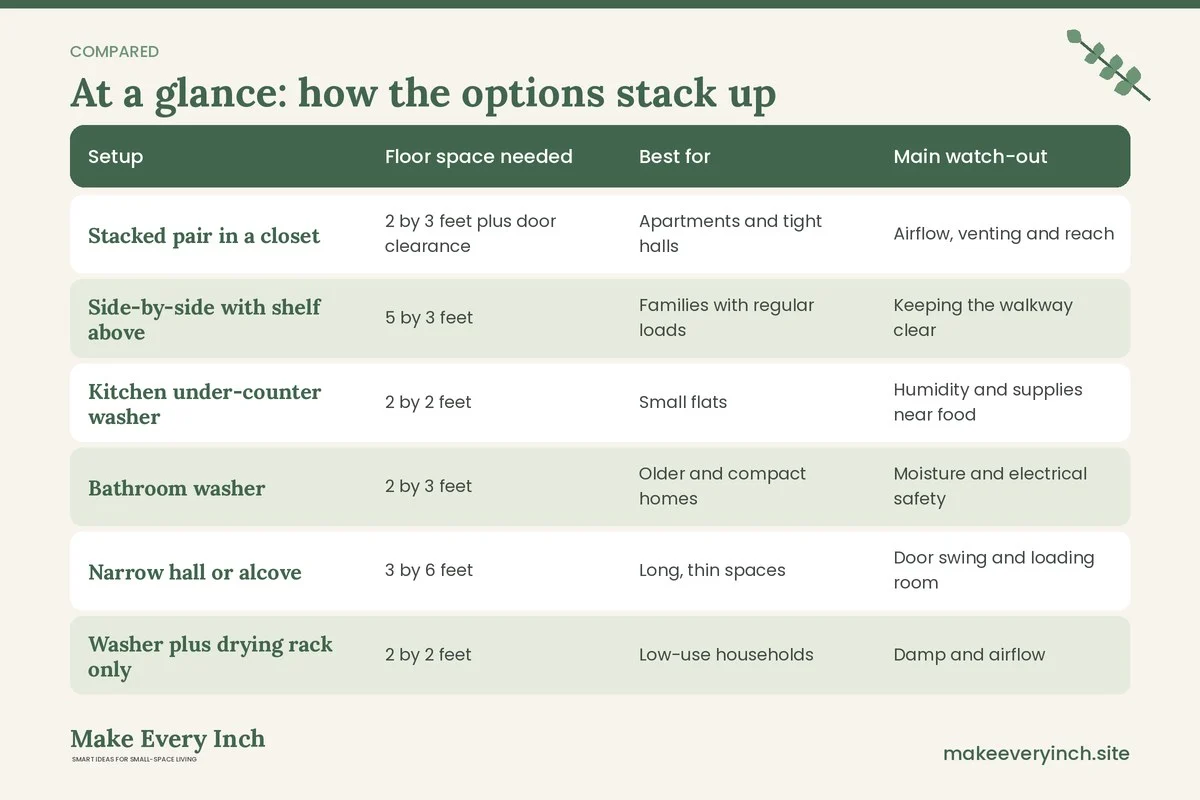
The table below compares the most common small laundry setups. Use it as a quick filter before you shop, and read the linked guide for each option.
| Setup | Floor space needed | Best for | Main watch-out |
|---|---|---|---|
| Stacked pair in a closet | 2 by 3 feet plus door clearance | Apartments and tight halls | Airflow, venting and reach |
| Side-by-side with shelf above | 5 by 3 feet | Families with regular loads | Keeping the walkway clear |
| Kitchen under-counter washer | 2 by 2 feet | Small flats | Humidity and supplies near food |
| Bathroom washer | 2 by 3 feet | Older and compact homes | Moisture and electrical safety |
| Narrow hall or alcove | 3 by 6 feet | Long, thin spaces | Door swing and loading room |
| Washer plus drying rack only | 2 by 2 feet | Low-use households | Damp and airflow |
| Utility closet shared with equipment | Varies | Homes with a boiler or panel | Keeping access clear |
Common mistakes to avoid
Most small laundry problems come from a few repeat errors. Buying storage before measuring, blocking the dryer vent, ignoring lighting, letting lint build up, storing chemicals within a child’s reach and leaving damp clothes in a closed room are the usual ones. Another mistake is covering the whole floor with baskets until nobody can move. Our post on small laundry room mistakes to avoid goes through them, with a fix for each.
A simple checklist for your small laundry
Use this list to plan, build and maintain your space.
- Write down how you do laundry and what you need to store.
- Measure the machines, the doors and the routes for hoses and vents.
- Keep the manufacturer’s clearances and about 30 inches in front of a front-loader.
- Stack the machines where the model allows it, using the proper kit.
- Use the wall above and beside the machines for shelves, rods and hooks.
- Cut down the number of products and label what is left.
- Store chemicals out of reach of children and pets, and never mix them.
- Plan a drying spot with airflow, away from the vent.
- Add a task light so you can see stains and labels.
- Clean the lint screen after every load and the vent system on a schedule.
- Check that outlets near water are GFCI protected, and test them monthly.
- Inspect water hoses for cracks and know where the shut-off valves are.
- Fit a smoke alarm, and a carbon monoxide alarm if you have gas appliances.
- Ask the landlord before drilling, painting or changing any connection.
- Review the setup every few months and adjust.
Frequently asked questions
How do I make a small laundry room feel bigger?
Use the vertical space, keep the floor clear and choose light colors. Shelves above the machines, a hook rail on the door and a good light make a small laundry feel open. Stacking the machines, where the model allows, frees floor space for a basket.
Where can I put a washer and dryer in a small apartment?
Common spots are a closet, a hall niche, a kitchen corner or a bathroom. The right choice depends on where water, drainage and venting already exist. Check the lease before you change any connection, and ask a qualified professional about installation.
What can I use instead of a countertop for folding?
A board over a front-loading pair, a fold-down wall shelf, a rolling cart with a flat top or a folding table all work. Never cover the dryer vent or the controls. If you stack the machines, a wall shelf or a cart is usually the best choice.
How often should I clean the dryer vent?
Clean the lint screen after every load. Have the full vent duct cleaned by a qualified professional on a schedule that fits your use, which for many homes is about once a year. Clothes that take longer to dry, a hot room or a burning smell are signs to act sooner.
Do laundry outlets need GFCI protection?
Many codes require it for outlets near water and in laundry areas, but rules vary by place and by the age of the home. Look for test and reset buttons, test them monthly and ask a qualified electrician if you are unsure.
How do I dry clothes in a small home without a dryer?
Use a folding rack, a wall-mounted rack, a ceiling pulley or a tension rod, and leave room for air to move. Run a fan or open a window to keep humidity down. Do not drape wet clothes over heaters.
Can I improve a laundry room if I rent?
Yes. Freestanding shelves, tension rods, over-the-door organizers and removable hooks all work without drilling. Check the lease, ask in writing before you change anything fixed and photograph the room before and after.
How can I set up a small laundry on a budget?
Start with what you already have: a basket, a shelf and a rod. Add storage only where it solves a real problem, and secondhand or DIY options can work well. See our pillar on budget small space ideas for more.
All our small laundry guides
Every guide in this cluster is listed below. Pick the one that matches your space or your question.
- Small laundry room organization: the starting system for sorting, storing and keeping the room calm.
- Small laundry area ideas for apartments: rental-friendly plans for halls, nooks and closets.
- Small laundry room storage ideas: vertical storage that clears the floor.
- Small laundry room ideas on a budget: low-cost fixes with big results.
- Small laundry room ideas for renters: reversible changes that respect the lease.
- Laundry closet organization ideas: make the most of a machine closet.
- Stacked washer dryer storage ideas: use the sides and the space around a stacked pair.
- Small laundry room shelf ideas: shelves that fit above machines and in gaps.
- Small laundry room drying rack ideas: racks, rods and pulleys for drying in tight spaces.
- Laundry room ideas in a bathroom: handle moisture and storage when the washer shares a bathroom.
- Laundry room ideas in a kitchen: hide the machine and keep supplies separate from food.
- Small laundry room countertop alternatives: fold surfaces when a counter will not fit.
- Small laundry room organization for families: simple systems for big loads and busy people.
- Small laundry room ideas for narrow spaces: layouts for halls and slim alcoves.
- How to organize laundry supplies in a small home: sort, label and store detergents and tools.
- Small utility closet organization ideas: store supplies without blocking equipment.
- Small laundry room lighting ideas: layer light so you can see stains and labels.
- Small laundry room ideas with a sink: plan shelves, storage and splash zones around a utility sink.
- Small laundry room ideas for older homes: work with odd corners, low ceilings and older wiring.
- Small laundry room mistakes to avoid: the common errors and how to fix them.
- Small laundry room ideas before and after: real-style makeovers and the choices behind them.
Keep going: Keep going with small laundry room storage ideas, small laundry room drying rack ideas and small laundry room organization.
Save this guide for later
Pin the ideas you like to Pinterest so you can come back to them when you plan your space.