Small Home Storage for Shared Spaces: 12 Ways to Divide It Fairly
Quick answer: Small home storage for shared spaces works best when every person owns a clearly marked zone, common items live in one labelled spot, and a short set of house rules covers overflow. Measure the storage you have, split it by real use rather than by equal inches, give each person a bin or shelf with a visible edge, and review the split every few months.
Small home storage for shared spaces is less a furniture problem than a fairness problem. When two or more people share a kitchen, a hallway, a living room or a single closet, the shelves fill up unevenly, one person’s things drift into another’s territory, and a small annoyance becomes a recurring argument. This guide shows how to divide storage in a way everyone can live with. It covers the audit, the numbers that make a split fair, 12 ideas, a zone table, three example households, house rules, safety notes and a checklist. For the wider topic, start with our pillar guide on small space organization ideas, and pair it with the post on small home organization for families.
Why shared storage fails in small homes
Storage in a shared home usually fails for three quiet reasons. The first is that nobody decided who owns what, so the first person to arrive claims the best shelf and everyone else works around them. The second is that common items, such as cleaning supplies, spare light bulbs, batteries and the toolbox, have no home of their own, so they migrate to whichever cabinet has room. The third is that people measure fairness by inches when they should measure it by use. A person who cooks every night needs more kitchen cabinet than a person who eats out, and a person who commutes by bike needs more entry space than one who walks.
The fix is to name the problem before buying a single bin. Sit down together with a notepad and ask three questions. What does each person own that needs storage? What do we all use? What do we rarely use but cannot throw away? The answers split the home into three kinds of storage: personal, shared and deep. Personal storage belongs to one person. Shared storage belongs to the household and sits where everyone can reach it. Deep storage holds seasonal or backup items in the hardest places to reach. Most arguments come from mixing the three.
Run a shared storage audit
Spend one weekend on the audit, and do it together if you can. Walk through each room and list every storage spot: cabinets, drawers, shelves, closets, under the bed, behind doors, the top of the fridge and the space above the wardrobe. Write down its approximate width, depth and height. Measuring takes little time and it ends the guessing. A kitchen with 6 linear feet of lower cabinet and 4 feet of upper cabinet looks different on paper than it does in your head.
Then empty one category at a time, starting with the one that causes the most friction. In many homes this is the kitchen, followed by the bathroom and the entry. Put everything on a table or a bed, sort it by owner, and look at the pile. You will often find duplicates, such as three can openers or four bottles of the same cleaner. Decide together what the household needs one of and what each person keeps privately. Our guide on decluttering rules for small homes gives simple tests for what to let go, and the post on small apartment decluttering ideas has a room-by-room order.
How to split storage fairly
Equal inches are rarely fair. Instead, use a simple weighted split.
- Start with equal shares. Divide each storage spot by the number of people as a baseline.
- Adjust for use. Give extra space to the person who uses that room’s items most. The cook gets more cabinet and the person with the bikes gets more hooks.
- Reserve a common share. Set aside 20 to 30 percent of each area for shared items. This is the part people forget, and it is the part that prevents drift.
- Keep one overflow spot. Choose one bin or shelf for things that have no owner yet. Empty it weekly.
- Trade, do not hoard. If one person has spare space in a cabinet, they can lend it, but the loan should be written down and easy to reverse.
A rough guide for two adults is a 40 percent, 40 percent and 20 percent split for personal, personal and common. For three people it may be closer to 28, 28, 28 and 16. These are starting points, not rules. Adjust them after a month of real life.
12 ways to organize small home storage for shared spaces
Make the edges visible
1. One bin per person
A bin gives each person a hard edge. Whatever fits in the bin is theirs, and when it is full the owner decides what to remove. Bins of the same size look tidy side by side, and a label or a colored tag makes ownership clear at a glance. For homes that prefer fewer containers, see our post on small home organization without buying bins.
2. Shelf dividers and tape lines
On an open shelf, a vertical divider or a strip of tape marks where one person’s section ends. Adjustable dividers can be moved as needs change, and tape is easy to peel. If the shelf is painted or varnished, test the tape in a hidden spot first.
3. A drawer each
Where a chest of drawers or a kitchen island has drawers, assign them. Drawers are easy to close on a mess, so they suit the personal zone better than the shared one. Use trays inside each drawer to keep small things from sliding together.
4. Matching hooks with name tags
In an entryway, give each person one hook and one shelf cubby. A small tag at each hook ends the pile of coats on the nearest chair. If the lease bans drilling, use over-the-door hooks or a freestanding coat rack, and read our guide on no-drill storage ideas for renters.
Give shared items a home
5. A household supply basket
Cleaning cloths, spare bulbs, batteries, tape and a small screwdriver set can share one lidded basket or tote on a high shelf. Put a note on the lid listing what is inside, and whoever uses the last battery adds it to the shopping list.
6. A shared shelf in the kitchen
Pick one shelf or cabinet at hand height for common pantry staples such as rice, flour, oil and spices. Everyone can use the items, and everyone restocks them. Personal snacks go in a bin in a lower or higher spot. Our post on how to organize a small kitchen covers the layout in more depth.
7. A paper and mail station
Shared mail piles up fast. Use a wall-mounted or freestanding sorter with one slot per person and one slot for the household, and clear it every weekend. For more on this subject, see small home paper organization ideas.
8. A cleaning cabinet with a lock option
Keep cleaning products together, off the floor and out of reach of children and pets. A cabinet latch or a high shelf is safer than an open bin under the sink. Never store chemicals next to food, and keep them in their original labelled containers.
Use vertical and flexible space
9. Closet split with a rod divider
A shared closet works better when the rod is split in half with a divider or a different hanger color for each person. Add stacking shelves at the sides and a hanging organizer on the back of the door. Our guide on small closet organization ideas shows how to fit two wardrobes into one.
10. Under-bed drawers for personal overflow
Low, flat drawers under a bed hold off-season clothes and extra bedding. If two people share a bed, give each side its own drawer. Keep the drawers on wheels or with handles, so they slide out without a struggle.
11. Tall storage, anchored
A tall shelving unit or bookcase is the best way to add storage in a small footprint, but it must be fixed to the wall. Anchor every tall unit with the hardware that comes with it, or use a method the landlord allows, and keep heavy items on the lower shelves. This is a particular concern where children or pets share the home. Never climb the shelves, and ask permission before drilling into any wall or ceiling.
12. A rolling cart as the flex zone
One cart that moves between rooms can be the pantry overflow in the morning, the craft station in the afternoon and the drinks cart in the evening. It belongs to nobody and everybody, which makes it a fair buffer when the permanent zones are full.
Zone table: who gets what
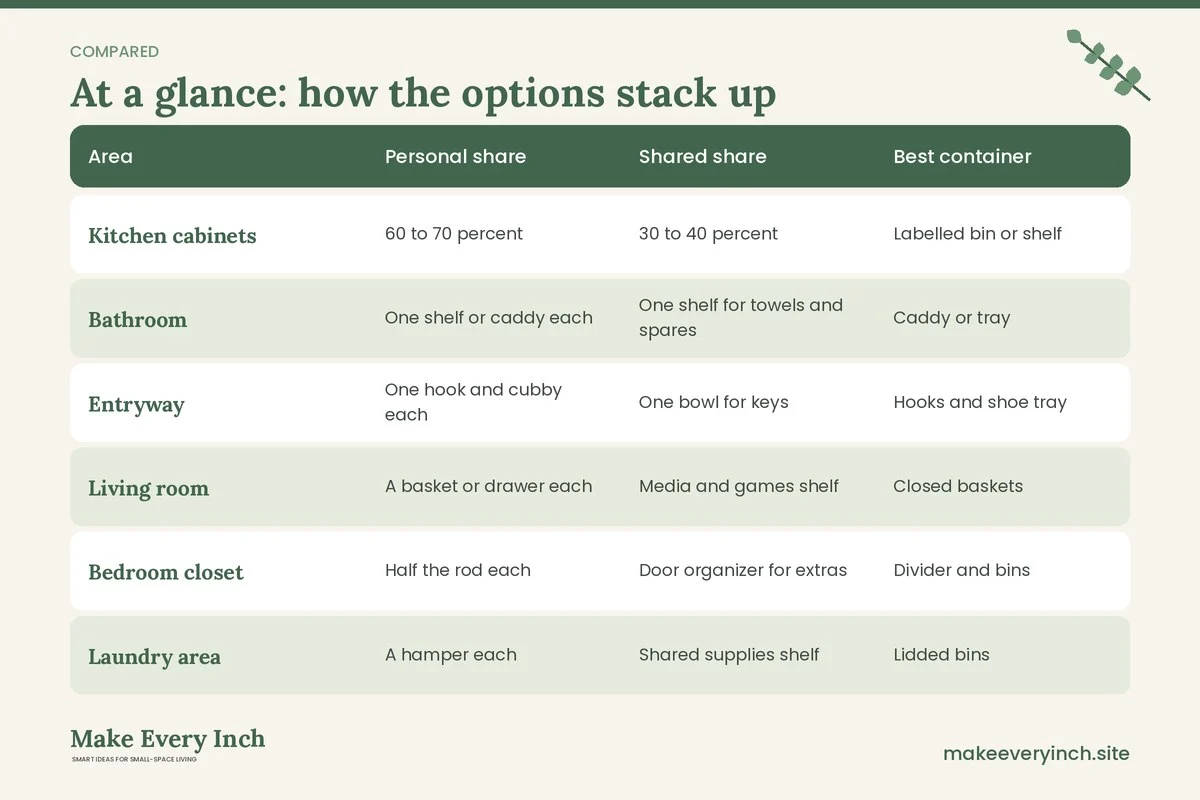
Use the table below as a starting framework for a household of two to four people. Adjust the shares after the first month.
| Area | Personal share | Shared share | Best container | Watch out for |
|---|---|---|---|---|
| Kitchen cabinets | 60 to 70 percent | 30 to 40 percent | Labelled bin or shelf | Duplicate gadgets |
| Bathroom | One shelf or caddy each | One shelf for towels and spares | Caddy or tray | Damp, so use waterproof containers |
| Entryway | One hook and cubby each | One bowl for keys | Hooks and shoe tray | Wet shoes on floors |
| Living room | A basket or drawer each | Media and games shelf | Closed baskets | Cables and cords |
| Bedroom closet | Half the rod each | Door organizer for extras | Divider and bins | Heavy items on high shelves |
| Laundry area | A hamper each | Shared supplies shelf | Lidded bins | Chemicals out of reach |
| Hall or storage nook | Top shelf for deep storage | Middle shelf for tools | Labelled totes | Weight limits and anchoring |
Three example households
Two roommates in a two-bedroom apartment
Each person has a bedroom, so personal storage is mostly sorted, and the arguments are about the kitchen, the bathroom and the hall. A sensible plan gives each roommate two kitchen cabinets, one or two shelves in the fridge and a lower drawer for their own gear. The household shares a third cabinet for staples, plus a basket of cleaning supplies. In the bathroom, each person gets a caddy or a shelf, and the towels go on separate hooks with different colors. A small whiteboard on the fridge lists shared items that are running low. Because roommates can leave on short notice, keep a short inventory of what is jointly owned and what belongs to each person. It removes friction at move-out.
A couple and one child in a one-bedroom apartment
Here the living room carries more than it should: toys, laundry, a work corner and the television. Zone the room with a low bookcase or a cabinet that separates a play area from an adult area, and use closed baskets so the room looks calm in the evening. Keep the child’s items low and reachable, and the adults’ items higher. Anchor the bookcase to the wall, cover or move sharp edges at toddler height, and keep small objects such as batteries and coins in a closed container on a high shelf. The entry gets three hooks at three heights, so the child can hang a bag without help. For more on this stage, see our post on small home ideas for families.
Three adults sharing a house with one bathroom
With three people and one bathroom, the bathroom is the pressure point. Give each person a lidded bin or a caddy that they carry to and from their room, and keep only shared items, such as toilet paper and cleaning supplies, in the room itself. Under-sink space is damp and often holds pipes, so use waterproof bins and check for leaks regularly. Where outlets are near water, use only those that are protected by a ground fault circuit interrupter, and keep hair tools unplugged and away from the sink when not in use. A hook rail on the back of the door holds towels, and a towel color for each person ends the guessing.
House rules that keep the split working
A fair split works only if people keep to it. Write a one-page agreement and tape it inside a cabinet door. Keep it short.
- Own your edge. Stay within your bin, shelf or hook set.
- Ask before borrowing. Using another person’s space needs a quick yes, and a time limit.
- Label shared goods. Anything the household owns together gets a mark, so nobody is confused.
- Clear the common surface weekly. The shared shelf, the mail station and the overflow bin get emptied every weekend.
- Review after 90 days. Check what is working, adjust the shares and replace anything that no longer fits.
- Leave a trail. If you remove a shared item, add it to the shopping list or the whiteboard.
The tone matters. Present these as a way to keep the home easy for everyone, not as a set of orders. Our post on small home organization mistakes to avoid lists the habits that undo a plan like this.
Safety notes for shared storage
Shared homes are busy homes, and storage choices can create hazards if they are rushed. Keep these points in mind.
- Anchor tall furniture. Bookcases, wardrobes and tall shelves can tip, especially with children or pets around. Use the supplied anchors and follow the instructions, or choose a freestanding low unit if you cannot drill.
- Respect weight limits. Check the stated capacity of every shelf, hook and over-door organizer, and spread heavy items along the bottom.
- Lease permission. Do not drill, glue or paint without the landlord’s written yes. Choose freestanding and removable options first.
- Electrical safety. Do not run extension leads through bins or under rugs, and do not overload one socket with a charging station for a whole household. Keep cables away from water and heat.
- Ventilation. Closets and cabinets that hold damp towels or cleaning products need air. Do not pack them tight, and leave a gap at the back.
- Low-VOC finishes. If you repaint a shelf or a cabinet, choose low-VOC paint, work with a window open and let it cure before loading it.
- Chemicals and medicines. Store them high, closed and in their original containers, away from children, pets and food.
- Fire safety. Keep paper and fabric away from heaters and stoves, and keep exits and smoke alarms clear.
Labels, colors and signals
Labels are cheap and they do more for shared storage than almost any container. Use one system and keep it simple. A color for each person works well for hangers, hooks, towels and bins, and it is easy for children to follow. A short label on the front of a bin does the rest. Where a household shares a language, use words; where it does not, use pictures. A label for the content, not the owner, works best for shared goods: write “batteries” rather than “Sam’s batteries”. Re-print labels when the contents change, because a label that lies is worse than no label.
Signals help too. A small clip on a shelf can show that a space is lent out. A magnet on the fridge can show that someone is out of an item. A weekly reset time, say Sunday evening, gives the household a rhythm and lets small problems get solved before they grow.
Handling overflow without a fight
Overflow is the time when the system is tested. One person buys in bulk, or a hobby grows, or a visitor leaves a bag for a month. Decide in advance how to handle it. First, ask whether the item deserves the space at all, using the usual tests of use, duplicates and joy. Second, look for deep storage: the top of a wardrobe, under a bed or a hall shelf. Third, consider swapping, so one person gets extra kitchen space and gives up an equal amount in the hall. Fourth, if none of this works, accept that the household has reached its limit and let the item go. A home that hits its limit is a home that is doing its job.
Seasonal items can also go in a shared deep-storage area. Label the totes with the season and the owner, stack the lightest on top and note the weight on the lid. Our post on small home ideas for seasonal changes shows how to rotate items without crowding the daily zones.
Shared storage for pets and hobbies
Pets and hobbies are the two things that most often break a storage plan. A dog or a cat adds food, leads, toys and grooming kit. Give the animal one bin or drawer, and keep food in a sealed container on a shelf the pet cannot reach. Keep medicine and cleaning products out of reach, and secure any low cabinet with a child-safety latch. For ideas, see small home ideas for pet owners.
Hobbies such as sewing, painting or gaming need their own zone and a clear boundary. A rolling cart or a single cabinet with a door contains the mess, and a rule that the hobby never spreads beyond its zone keeps the peace. Paints, glues and solvents need good ventilation and should be stored in a closed cabinet away from heat, with the lid tight.
A simple monthly reset for shared homes
Plan a 20-minute check on the first Sunday of each month. Walk the home with a basket and a list. Put stray items back in their zone, empty the overflow bin, check that the shared supplies are stocked and ask each person one question: is there a spot that is not working? Small adjustments, such as moving a basket, swapping a shelf or adding a hook, keep the system alive. Every three months, repeat the audit for one room. Over a year this adds up to a full review of the home without a weekend of upheaval. For a long-term plan, read our post on small home organization ideas that actually last.
Shared storage checklist
- Measure every cabinet, shelf and closet in the home.
- List what each person owns and what the household shares.
- Sort items into personal, shared and deep storage.
- Remove duplicates and expired items together.
- Split each area using a weighted share, with 20 to 30 percent for common items.
- Give every person a bin, drawer or hook with a visible edge.
- Label shared goods by content.
- Set up one overflow spot and empty it weekly.
- Anchor tall furniture and check weight limits.
- Get written lease permission before drilling.
- Store chemicals and medicines high and closed.
- Write a one-page agreement and review it after 90 days.
FAQ
How do roommates split kitchen storage fairly?
Start with equal cabinets, then adjust for who cooks more. Reserve one shelf for shared staples and give each person a labelled bin. Agree on a rule for fridge shelves as well.
What if one person has far more belongings than the others?
Weigh the split by use, not by equal inches, and ask the person with more to use deep storage, such as under-bed drawers, or to edit the collection. A calm conversation about the home’s limit works better than a fight about shelves.
How do I organize a shared closet?
Divide the rod in half, use hangers of different colors, and give each person a shelf or a bin. Add a door organizer for shared extras, and put seldom-used items on the top shelf.
Can we do this in a rental without drilling?
Yes. Use freestanding shelves, over-door hooks, tension rods and rolling carts. Ask the landlord in writing before drilling anything, and keep tall units anchored by a method the lease allows.
How often should we review the plan?
Check in after 90 days, then twice a year. Adjust when someone moves in or out, a baby arrives or a hobby grows.
How do we keep children out of shared supplies?
Store cleaning products, medicines and small objects high, in closed containers, and use cabinet latches on lower doors. Give children their own low bin for safe items.
Keep going: Keep going with our guides on small home organization for busy people, small home ideas for shared bedrooms and small home office ideas for shared spaces.
Save this guide for later
Pin the ideas you like to Pinterest so you can come back to them when you plan your space.