12 Small Space Upgrades Worth Spending On (and How to Rank Them)
Quick answer: The small space upgrades worth spending on are the ones you touch or see every day: lighting you can control, a bed or sofa that fits the room, a door or wall hook system, full-height storage, window coverings hung high, a proper mattress and bedding, a better chair for your desk, and a few hardworking surfaces. Rank each idea by how often it is used, how many problems it solves and whether it moves with you. Spend on the top of that list and save on everything else.
Small space upgrades worth spending on share one quality: they pay you back every single day. In a small home, money does not stretch as far as the square footage does not stretch, so each purchase needs to earn its place. A candle set or a trendy accent chair might look good for a month, but a lamp you switch on every evening or a hook you use every morning works for years. This guide gives you a simple way to rank upgrades before you buy, then walks through 12 upgrades that usually repay the money, a payoff table, three example rooms with different budgets, safety and lease notes, and a checklist you can use in a store or at a screen. If you want a broader plan for stretching money, start with our hub on budget small space ideas.
The three-question test for any upgrade
Before putting any item in a basket, ask three questions. They take about a minute and prevent most regrets.
1. How many times a week will I use or notice it? An upgrade you use daily is easy to justify. An upgrade you use twice a year needs to be very cheap or very good. Count honestly: a bedside lamp is used every night, a decorative tray is used when guests visit.
2. How many problems does it solve at once? A bench that gives seating, shoe storage and a place to put bags solves three problems in one footprint. A purely decorative object solves one. In a small space, floor area is the scarcest resource, so multi-problem items win.
3. Will it still work in my next home? Renters move, and household situations change. A freestanding shelf, a good lamp, a bed frame and a mattress all travel. A custom fix for a quirky corner of this apartment may not. That does not make it a bad buy, but it should be cheaper than a portable one.
Score each idea one to three on each question. Anything above seven is a strong candidate. Anything at five or below can wait, or can be done a cheaper way.
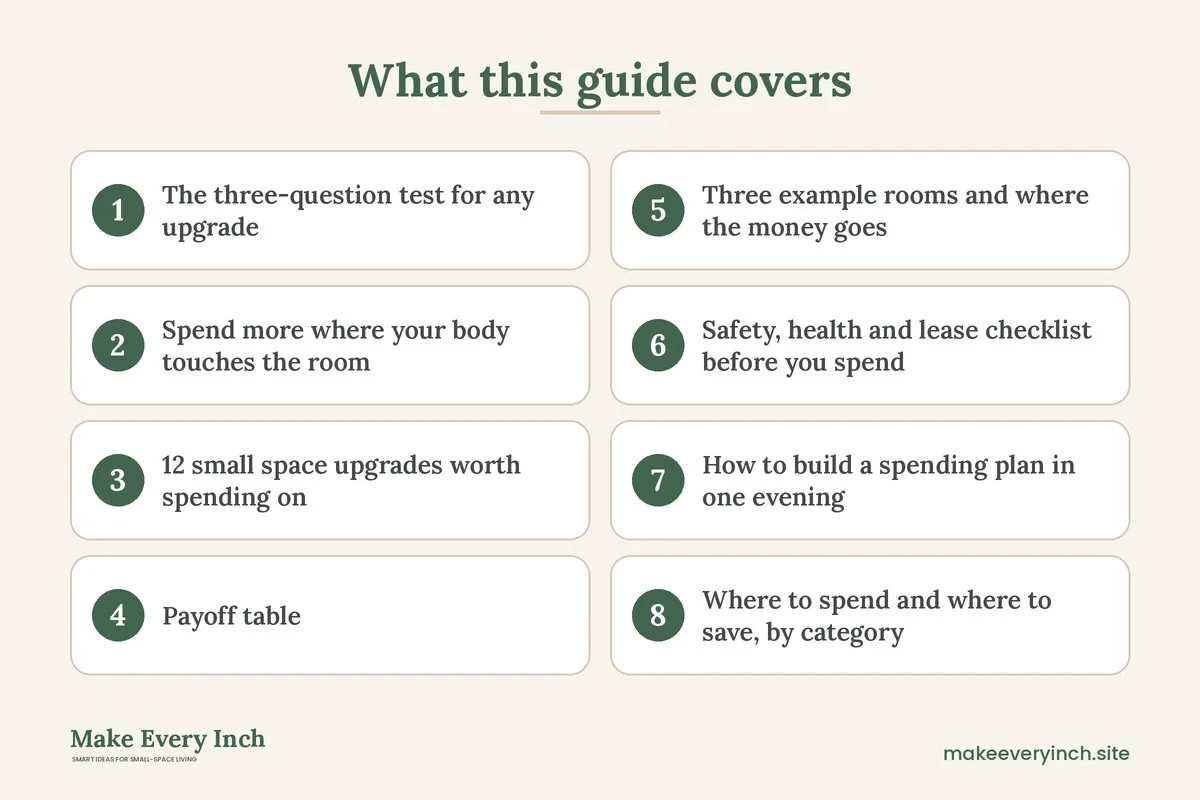
Spend more where your body touches the room
The first rule of small space spending is that you should pay for contact. These are the points where your body meets your home many times a day: the mattress, the chair, the sofa seat, the work surface and the light by which you read. A small room does not forgive discomfort, because you cannot retreat to another room to escape a bad chair. If you spend little on a decorative item, you can afford to spend a little more on the item that you sit or lie on for hours.
Second, pay for what supports your routine. A morning routine in a small home is a chain of small actions: take off shoes, hang a coat, put down keys, charge a phone, find the bag. When one link breaks, the whole chain feels cramped. A hook, a tray or a charging spot removes friction and makes the room feel larger, because less is lying around waiting to be put away.
Third, save on anything that exists mainly to be looked at. That does not mean looks do not matter. It means looks are cheapest to fix with low-cost, swappable things such as fabric, art prints, plants and paint (when allowed), while function is expensive to fix later.
12 small space upgrades worth spending on
Light and air
1. A controllable main light
Many rentals come with one harsh overhead fixture. Adding a dimmable bulb, a plug-in wall lamp or a floor lamp with a warm bulb gives you control without wiring. Rooms feel bigger and calmer at night when light comes from several heights. Choose bulbs that fit the fixture, check the wattage limits printed on the socket, and never cover a hot bulb with fabric or paper. For more on layers, read our guide to layered lighting ideas for small apartments and the renter side in renter friendly lighting ideas.
2. Curtains hung high and wide
A rod set closer to the ceiling than to the window frame, with panels that extend beyond the glass, makes a window look taller and lets more daylight in when open. This is one of the best returns in a small room because it changes how tall the whole wall looks. Use a tension rod or an over-the-door style bracket if drilling is not allowed, and check the weight limit for heavy fabric. See small space curtain ideas to add height for rod and panel measurements, and renter friendly window treatment ideas for no-drill options.
3. A fan or air circulation fix
Stale or humid air makes a small room feel smaller. A quiet fan, a kitchen or bathroom vent that actually vents, and a habit of airing the room each day matter more than most decor. In wet areas such as bathrooms and kitchens, keep plug-in appliances away from water and use outlets with ground-fault protection (GFCI) where the building provides them. If you notice persistent damp or mold, tell the landlord in writing rather than covering it up.
Furniture that earns its footprint
4. A bed that fits the room and stores things
In a bedroom, the bed takes up the most space and gets the most use. A frame with drawers, or a simple frame raised enough for bins underneath, adds storage without new furniture. Measure the walkway on each side: aim for at least 24 inches on the sides you use, and more at the foot if the door opens there. Our guide to under bed storage ideas covers bin sizes and loading, and best storage beds for small bedrooms lists what to look for.
5. A sofa or chair scaled to the room
A sofa that is too large dominates the floor plan and forces every other piece into the leftovers. A slimmer arm, raised legs and a seat depth that fits your body are worth more than extra width. Measure the doorway, the stairs and the corners before ordering. For a deeper look, see how to choose a sofa for a small living room.
6. One piece of double-duty furniture
A storage ottoman, a drop-leaf table, a bench with a hollow base or a daybed that doubles as a sofa can replace two items. Check hinges and lids for pinch points, and avoid lids that slam shut when children or pets are around. Browse small space furniture ideas that do double duty for sizes.
7. A real desk chair
If you work or study at home, a chair that supports your back and lets your feet rest flat is one of the few items where spending more can protect comfort. Choose a chair with adjustable height and, if the room is tight, one that tucks fully under the desk. Pair it with a desk that leaves knee room; our small home office ideas show layouts.
Storage you will actually use
8. Full-height shelving, anchored
Vertical space is the cheapest square footage in a small home. A tall bookcase or shelving unit holds far more than a low one in the same footprint. Always anchor tall furniture to a wall stud or use the manufacturer’s anti-tip hardware. Tall units can tip, particularly when drawers are open or when children climb. If you rent and cannot drill, ask permission first; many landlords agree to a pair of small screw holes for safety. Ideas live in vertical storage ideas and renter friendly shelving.
9. A hook and rail system by the door
A row of sturdy hooks, a wall rail or an over-the-door organizer removes the daily pile of coats, bags and scarves. Match the hook to the load: a heavy bag needs a hook rated for it, and over-the-door hooks need enough clearance not to scratch the door. See our small entryway storage roundup and behind the door storage ideas for entryways.
10. Drawer and shelf dividers
Dividers cost little and change how well a drawer works. They turn a jumble into a system, which saves time every day. Spend on dividers sized to your drawers rather than on a big bin collection. Read small kitchen drawer organization ideas and small closet organization ideas.
Quiet comfort
11. Bedding and a mattress topper or mattress that suits you
Sleep is the single biggest use of a bedroom. If your mattress is worn out, replacing it or adding a topper often does more for daily life than any decor project. Choose by firmness preference and body comfort rather than by marketing claims, and check how the item arrives, because a large box may not fit in a narrow stairwell.
12. Cord and cable control
Loose cords make a small room look busy. A power strip with surge protection (rated for the load you plug in), cable clips and a cord cover tidy the space for little effort. Never run cords under rugs or through door frames, and never daisy-chain power strips. Read renter friendly ways to hide cords.
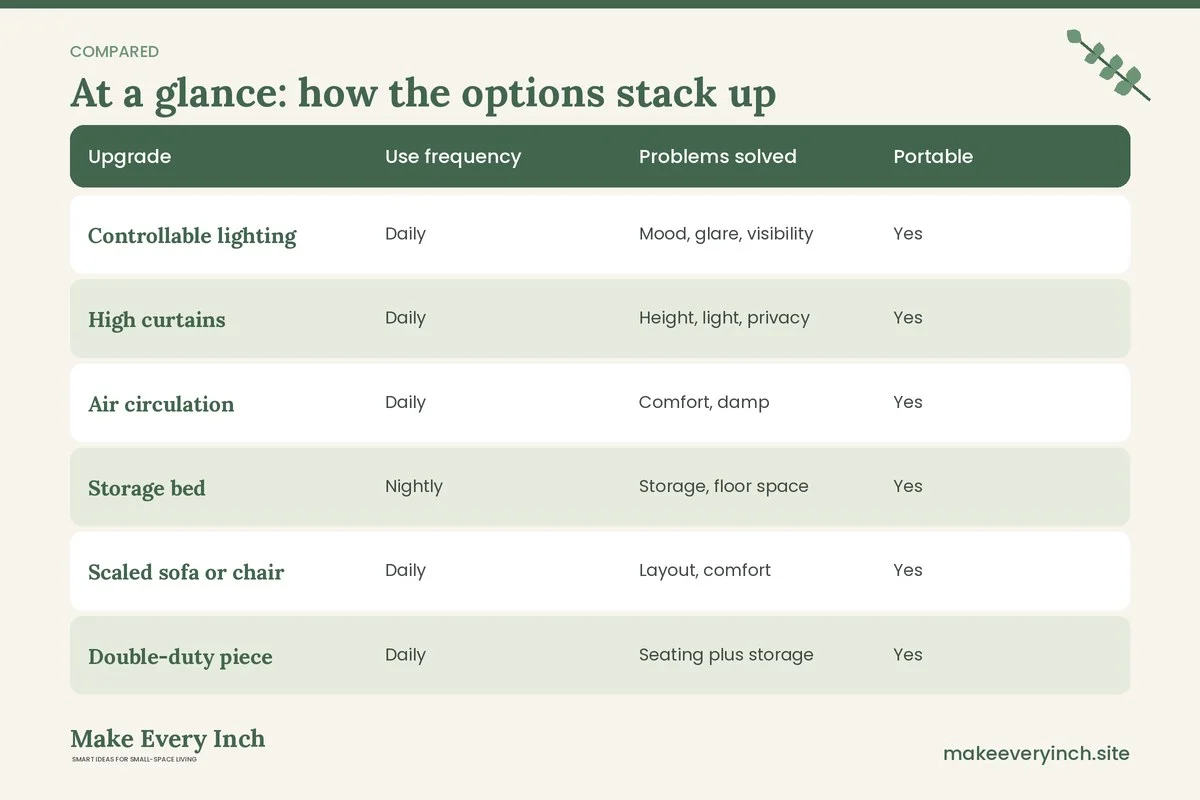
Payoff table: what to expect from each upgrade
| Upgrade | Use frequency | Problems solved | Portable | Spend level | |
|---|---|---|---|---|---|
| Controllable lighting | Daily | Mood, glare, visibility | Yes | Low to medium | |
| High curtains | Daily | Height, light, privacy | Yes | Low to medium | |
| Air circulation | Daily | Comfort, damp | Yes | Low to medium | |
| Storage bed | Nightly | Storage, floor space | Yes | Medium to high | |
| Scaled sofa or chair | Daily | Layout, comfort | Yes | Medium to high | |
| Double-duty piece | Daily | Seating plus storage | Yes | Low to medium | |
| Desk chair | Daily | Posture, focus | Yes | Medium | |
| Anchored tall shelf | Daily | Storage, safety | Yes | Medium | |
| Door hooks | Daily | Clutter, routine | Mostly | Low | |
| Dividers | Daily | Order | Yes | Low | |
| Bedding or mattress | Nightly | Sleep | Yes | Medium to high | |
| Cord control | Daily | Visual calm, safety | Yes | Low |
Treat the spend level as a guide only. Prices vary widely by location and season, so compare options yourself before you commit.
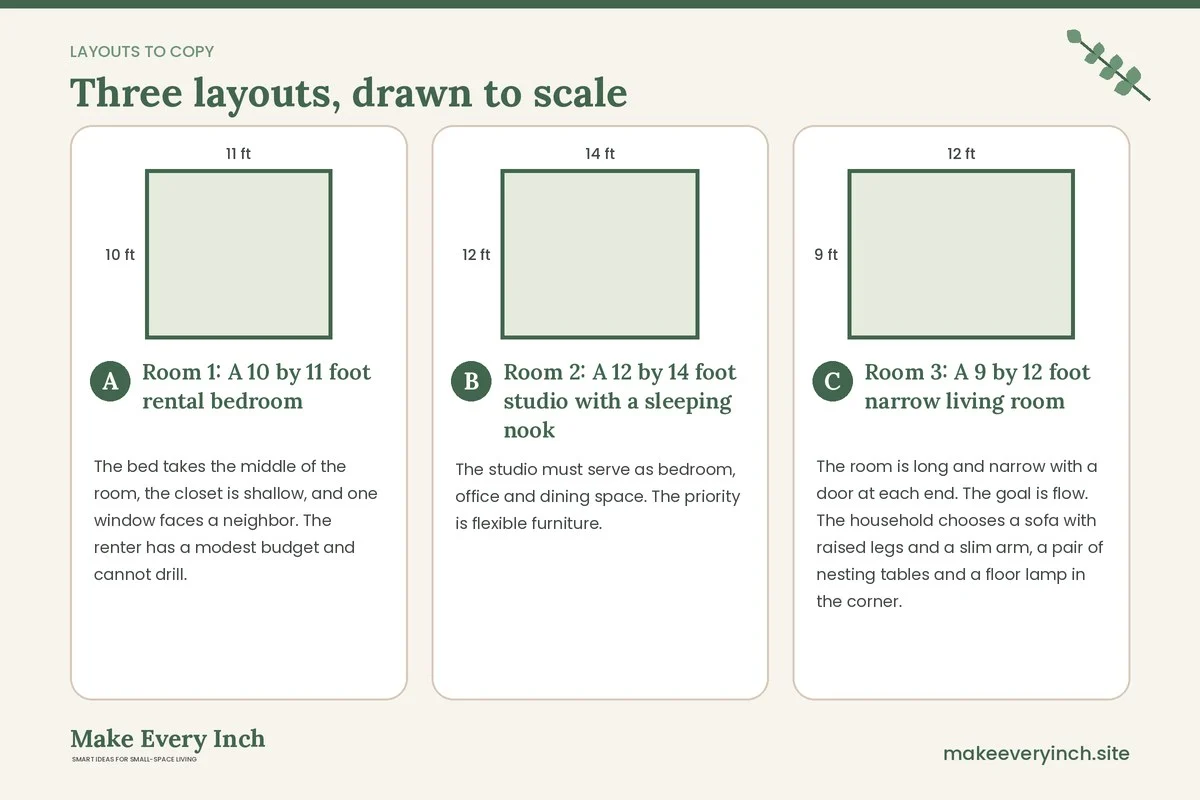
Three example rooms and where the money goes
Room 1: A 10 by 11 foot rental bedroom
The bed takes the middle of the room, the closet is shallow, and one window faces a neighbor. The renter has a modest budget and cannot drill. The best sequence is to start with free or very cheap items first: clear the floor, fold winter clothes into bins under the bed, and hang a second rod on the closet using a no-drill closet rod hanger rated for the load. Then spend on the top three items: curtains hung high on a tension rod, a dimmable bedside lamp and better bedding. The tall dresser stays anchored to the wall with a strap, with permission. Everything here moves out with the renter.
Room 2: A 12 by 14 foot studio with a sleeping nook
The studio must serve as bedroom, office and dining space. The priority is flexible furniture. The resident invests in a drop-leaf table that serves as desk and dinner table, one good chair and a bookshelf that doubles as a light room divider. The shelf is anchored and loaded with heavy items on the bottom. The rest of the budget goes to lighting, with three sources at different heights for each zone. The resident skips art, buys a few cheap prints later and uses plants where there is light. For layouts, see studio apartment layout ideas that create zones.
Room 3: A 9 by 12 foot narrow living room
The room is long and narrow with a door at each end. The goal is flow. The household chooses a sofa with raised legs and a slim arm, a pair of nesting tables and a floor lamp in the corner. Instead of a large rug, they pick one sized so the front legs of the sofa rest on it. They add a mirror across from the window, leaning rather than hanging, and tidy cords with clips. They avoid a heavy media console and mount nothing without permission. See narrow living room ideas for more.
Safety, health and lease checklist before you spend
- Anchor tall furniture. Bookcases, dressers and wardrobes should be fixed to the wall or secured with anti-tip hardware, especially in homes with children or pets.
- Electrical limits. Do not overload outlets or power strips. Check the rating on lamps and bulbs. Keep cords out of walkways and away from heat.
- Wet areas. Use outlets with ground-fault protection near sinks and tubs. Keep plug-in devices away from water.
- Paint and finishes. If your lease allows painting, choose low-VOC paint and ventilate the room during and after application. Allow paint to cure fully before putting furniture against it.
- Weight limits. Respect the weight rating on hooks, adhesive strips, rods and shelves. Use the lower of the posted ratings if you are unsure.
- Lease permission. Do not drill, paint or alter fixtures without written permission. Take dated photos of the room before any change.
- Child and pet safety. Keep cords, small parts and heavy items out of reach, and avoid items that can pinch or topple.
How to build a spending plan in one evening
Write down every item you have considered buying. Next to each, score the three questions. Sort by score. Draw a line at the budget. Anything above the line gets bought in order, one at a time, so you can judge each upgrade before you buy the next. This slow approach is a quiet strength: you learn what actually helps. You may find that moving a chair or clearing a surface provides most of the benefit you were hoping to buy.
Wait a few days before each purchase over a threshold you choose. Many wants fade. Look for secondhand versions of sturdy items such as shelves, tables and chairs, which often cost less and last longer than flat-pack equivalents; see thrifted furniture ideas for small homes. Inspect secondhand pieces for stability and check that tall items can be anchored.
Where to spend and where to save, by category
Light: spend on a good lamp and bulbs, save on shades and decor. Seating: spend on the seat you use daily, save on accent chairs. Beds: spend on the mattress and bedding, save on the headboard. Storage: spend on the one tall unit that serves several needs, save on small decorative boxes. Walls: save, use prints and removable options; see removable wallpaper ideas if you want color. Floors: a rug that suits the room is worth spending a little on, since it sets the zone and softens sound.
Common mistakes when spending
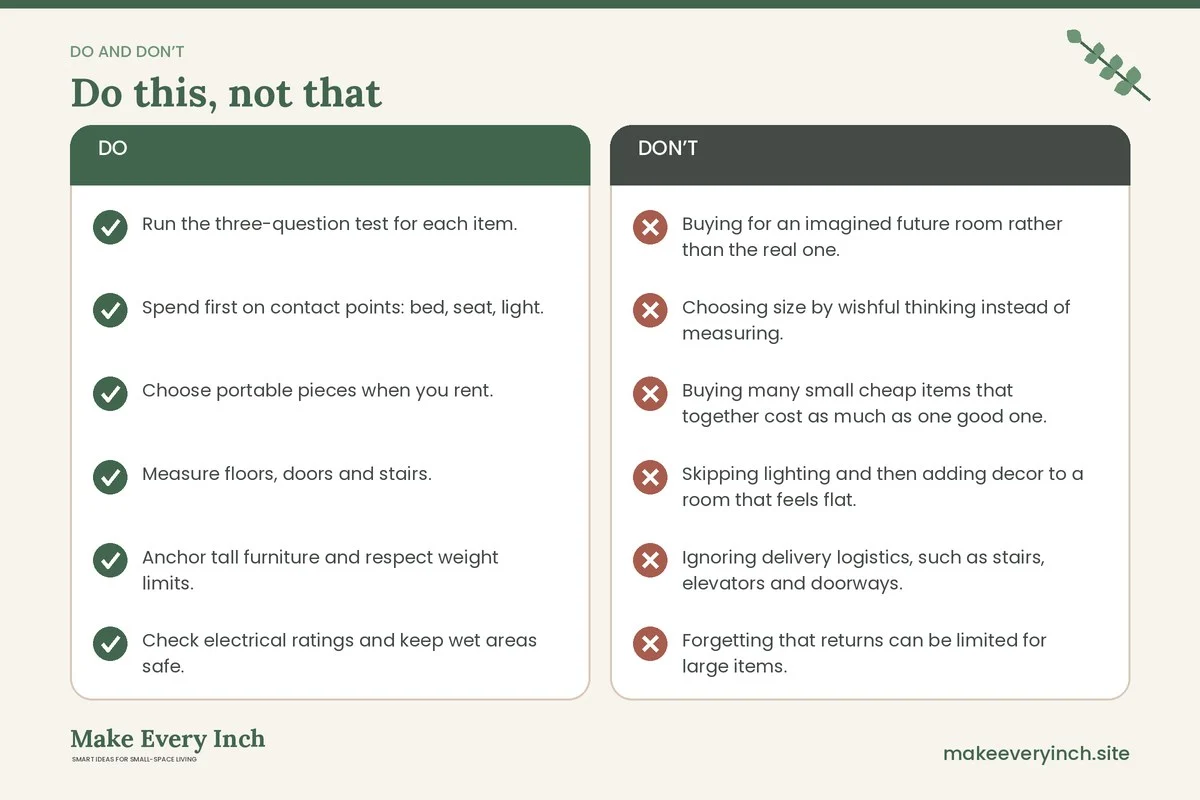
- Buying for an imagined future room rather than the real one.
- Choosing size by wishful thinking instead of measuring.
- Buying many small cheap items that together cost as much as one good one.
- Skipping lighting and then adding decor to a room that feels flat.
- Ignoring delivery logistics, such as stairs, elevators and doorways.
- Forgetting that returns can be limited for large items.
For a longer list of pitfalls, read small space decorating mistakes to avoid and small space furniture mistakes to avoid. If you would rather see the opposite view, our sibling guide on small space upgrades not worth the money covers what to skip.
FAQ
What is the single best first upgrade for a small space?
For most rooms it is lighting, since it changes how the whole space feels at night and costs less than furniture. If your room already has good light, move to storage that gets items off the floor.
Should I spend on furniture or decor first?
Furniture and function first. Decor can come later and is easy to add cheaply. A room with good furniture and bare walls feels livable, while a room with lots of decor and poor function feels cluttered.
How do I know if an upgrade is worth the money?
Run the three-question test: how often will you use it, how many problems does it solve, and will it move with you. If it scores high on all three, it is a strong buy.
Is it worth upgrading a rental?
Yes, if the upgrade is portable or if the improvement to daily life outweighs the cost. Choose freestanding and removable options, and get written permission for anything that touches the walls, fixtures or finishes.
Can I do these upgrades with a small budget?
Yes. Several are low cost, including hooks, dividers, cord control and a better bulb. Do those first and save for the medium ones. A well-chosen low-cost item can beat an expensive item chosen in a hurry.
How do I avoid buying furniture that is too big?
Mark the footprint on the floor with painter’s tape, measure doorways and stairs, and leave at least 24 to 30 inches for main walkways. If the item blocks a door or drawer, it is too large.
Final checklist
- Run the three-question test for each item.
- Spend first on contact points: bed, seat, light.
- Choose portable pieces when you rent.
- Measure floors, doors and stairs.
- Anchor tall furniture and respect weight limits.
- Check electrical ratings and keep wet areas safe.
- Get written permission before drilling or painting.
- Buy one upgrade at a time and judge the result.
Keep going: Keep going with budget small space ideas, pick small wins from small home improvements with the biggest impact, or stretch your budget further with small space decorating ideas on a tight budget.
Save this guide for later
Pin the ideas you like to Pinterest so you can come back to them when you plan your space.