Best Furniture for a Small Living Room: 12 Pieces Worth Buying
Quick answer: The best furniture small living room plans start with a compact sofa or loveseat, one flexible seat, a lift-top or nesting table, a slim media unit and a tall narrow bookcase. Pick pieces on raised legs, keep 30 to 36 inches for the main walkway, measure doors and stairs before buying, anchor tall pieces to the wall with permission, and buy in order of daily use.
Choosing furniture small living room owners can live with is mostly a measuring exercise, not a style exercise. A room of 10 by 12 feet can hold a sofa, a seat, a table, storage and a TV, but only when every piece is the right depth, the right height and the right visual weight. This guide is a buying plan. It lists the 12 piece types that earn their space, the size limits for each, a table that shows which to buy first, three example rooms, delivery and safety checks, and a checklist. For the full overview of the room, start with our small living room ideas pillar. If you want a broader list of looks and combinations, our small living room furniture ideas post covers those, while this guide focuses on what to choose, in what order, and at what size.
Measure before you shop
Furniture that looks small in a showroom can overwhelm a real room. Before you browse, collect six numbers and write them on one page.
- Room length and width, measured wall to wall at floor level and again at shoulder height, since baseboards and radiators change the usable space.
- Door and hall widths, including the narrowest point on the way in, such as a stair turn, a lift or a hallway corner.
- Window sill height, so a sofa back or a bookcase does not block light or a radiator.
- Outlet and vent positions, so nothing sits over a heating vent or hides the only outlet.
- Ceiling height, which sets the limit for tall storage.
- Walkway targets, which are 30 to 36 inches for the main path and 24 inches for a side path.
Our guide on how to measure furniture for a small room walks through the tape and paper method. A quick version is to cut cardboard or paper to the footprint of each candidate piece and lay it on the floor. Walk around the shapes for a day. If you keep stepping on one, it is too big or in the wrong place.
The rules that decide what fits
Five rules explain most good and bad furniture choices in a small living room.
1. Depth matters more than width. A sofa 32 to 36 inches deep leaves much more floor than one 40 inches deep, and a media unit 12 to 16 inches deep leaves more than one 20 inches deep.
2. Legs let the floor show. Pieces raised 6 to 10 inches on visible legs let the eye see under them, which makes the room read as larger.
3. Fewer, larger pieces beat many small ones. Five little tables read as clutter. One good table reads as calm.
4. Every big piece should carry a second job. Storage, a surface, a guest bed or a fold-away function justifies the footprint.
5. Keep the path clear. A beautiful room that you cannot walk through is not working. See our small space furniture layout rules for the full set.
The 12 pieces worth buying
Seating
1. A compact sofa or loveseat
The sofa sets the scale of the whole room. For most rooms under 120 square feet, aim for a length of 60 to 78 inches and a depth of 32 to 36 inches, with a seat height of about 17 to 19 inches. Arms that are narrow, around 3 to 5 inches wide, save more floor than you expect. Raised legs and a back that is not much higher than 33 to 35 inches keep the shape light. For selection tips, read how to choose a sofa for a small living room and the roundup of best sofas for small apartments.
2. A small sectional or a chaise piece, when the room is long
A narrow sectional can work in a room that is at least 11 feet long, since it uses a corner that otherwise stays empty. Check the delivery path and the leg of the L before ordering. See best sectionals for small living rooms for the trade-offs.
3. One flexible accent seat
A single armchair of 26 to 30 inches wide, a pair of poufs or a slim bench adds seats without filling the room. A chair with a swivel or a light frame can face the TV or the window. Poufs tuck under a console when not in use.
4. A sofa alternative when floor space is tight
A daybed, a bench with cushions, or a pair of chairs can replace a sofa in a very narrow room. These choices keep the floor open and still give two or three seats. Our list of sofa alternatives for small living rooms covers the options.
Tables
5. A coffee table that earns its footprint
The usual rules are a height within 1 to 2 inches of the seat height, a length about half to two thirds of the sofa, and 14 to 18 inches of gap between the table and the sofa. In a small room, round tables, nesting pairs and lift-top tables are the most forgiving. A table with an open frame or a glass top lets the floor show. If the room is very tight, see small living room ideas without a coffee table. For picks, read best coffee tables for small living rooms.
6. A side table that doubles as storage
A drum table, a cube with a lid or a small chest at the sofa arm holds a drink, a lamp and a few items inside. Keep the top at the arm height, around 20 to 26 inches, and about 12 to 16 inches wide.
Storage and media
7. A slim media unit
A low unit 12 to 16 inches deep holds a router, a console and a few baskets without jutting out. Wall-mounted units free the floor further. Check weight limits and wall type, get permission before drilling and use a stud finder for anything that carries load. For wall plans see small living room TV wall ideas.
8. A tall narrow bookcase
Vertical storage is the best use of a small footprint. A bookcase 10 to 12 inches deep and 60 to 72 inches tall holds books, baskets and decor. Anchor it to the wall with the straps or brackets supplied, since a tall unit can tip, especially with children or pets in the home. Our list of best narrow bookshelves has features to compare.
9. A storage ottoman or bench
One upholstered piece can be a footrest, a seat, a surface and a hidden box for throws and games. Choose a lid that closes slowly or has a soft hinge, so small fingers are safe. Our guide to best storage ottomans lists features worth checking.
10. A console or a narrow shelf behind the sofa
In an open plan, a console 10 to 14 inches deep behind a floating sofa gives a place for a lamp, a bowl and a plant, and it softly divides the room from the entry or dining space.
Multi-use and soft pieces
11. A fold-away or convertible piece
A drop-leaf table, a wall desk that folds down or a sofa that converts into a bed lets the room change function through the day. Check the weight rating, the hinge hardware and the wall, and avoid any fold-down unit that needs anchors in a rental unless the lease allows it. For more, see small space ideas with fold-down furniture and furniture ideas that do double duty.
12. A rug that anchors the group
A rug is not strictly furniture, yet it decides how the pieces read. In most small rooms, a 5 by 8 foot rug that lets the front legs of the sofa and chair rest on it holds the group together. See how to choose rug size for a small living room. Use a thin, non-slip pad and keep the edges flat, so no one trips.
Which piece to buy first
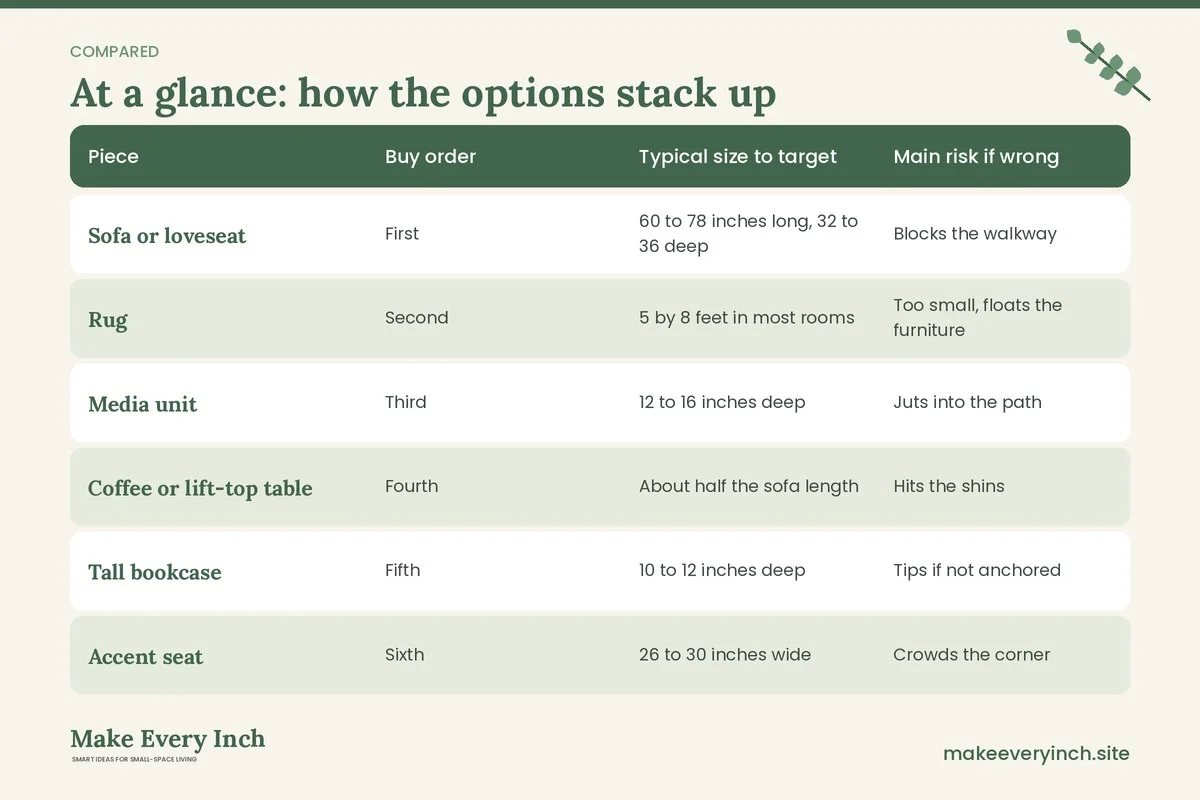
Buying in the right order matters more than buying the perfect set. This table ranks each piece by how much it changes daily life and how risky it is to get wrong.
| Piece | Buy order | Typical size to target | Main risk if wrong |
|---|---|---|---|
| Sofa or loveseat | First | 60 to 78 inches long, 32 to 36 deep | Blocks the walkway |
| Rug | Second | 5 by 8 feet in most rooms | Too small, floats the furniture |
| Media unit | Third | 12 to 16 inches deep | Juts into the path |
| Coffee or lift-top table | Fourth | About half the sofa length | Hits the shins |
| Tall bookcase | Fifth | 10 to 12 inches deep | Tips if not anchored |
| Accent seat | Sixth | 26 to 30 inches wide | Crowds the corner |
| Storage ottoman | Seventh | About 30 by 18 inches | Too heavy to move |
| Console or shelf | Eighth | 10 to 14 inches deep | Cuts the path |
This order works because the sofa decides the room, the rug decides the zone, and everything else fits around those two. If the budget is tight, the first three often make the room usable. Our post on budget friendly furniture ideas for small apartments offers ways to stage purchases, and thrifted furniture ideas for small homes explains how to check second-hand pieces.
Materials, finishes and visual weight
Two pieces of the same size can feel very different. Light visual weight keeps a small room open.
- Legs and frames: slim metal or wood legs show the floor. Skirted sofas and solid plinths feel heavier.
- Tops: glass, light wood and open frames read as lighter than dark, thick slabs.
- Color: furniture close to the wall color blends in. A sofa in a soft neutral near the wall tone recedes, while one dark piece makes a strong anchor if you only use one.
- Fabric: tight weave and performance fabrics wipe clean more easily in a busy home. Check care labels.
- Edges: rounded corners are kinder in tight walkways and safer around children.
If you want a deeper look at what makes pieces read as lighter, see our post on furniture that makes small rooms feel bigger.
Three example rooms
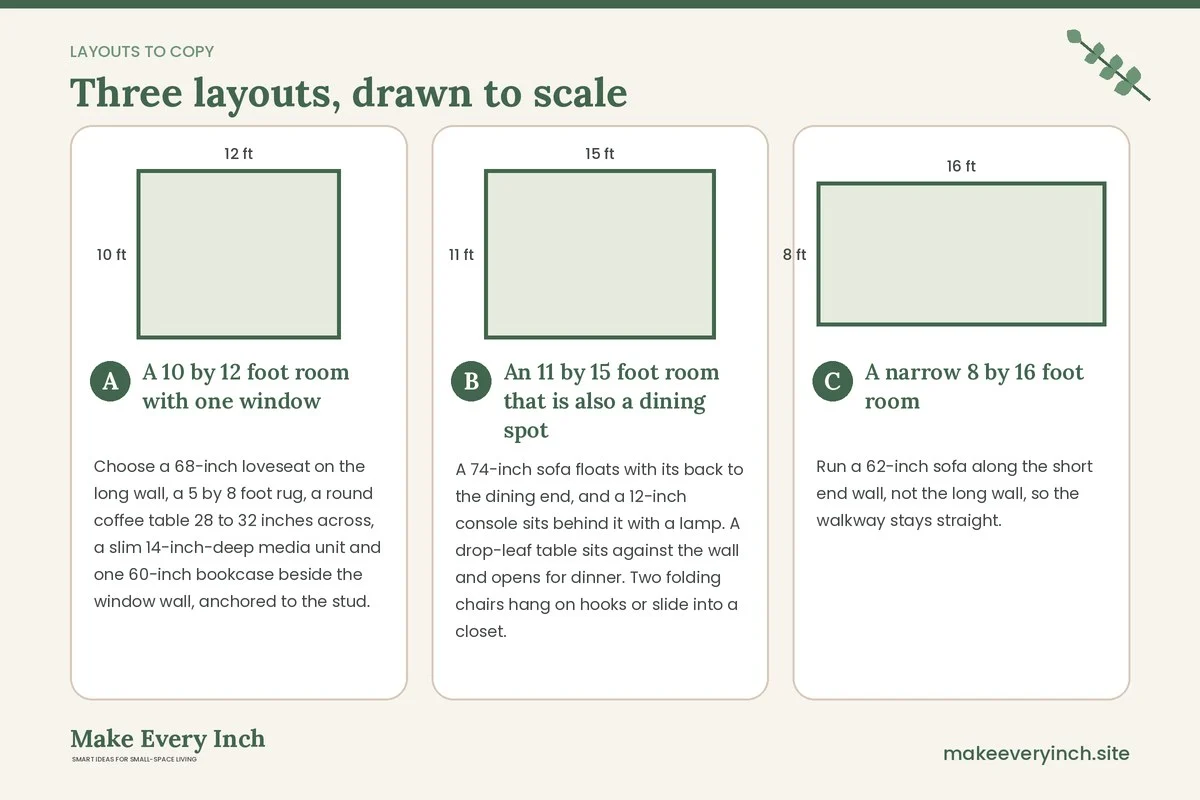
A 10 by 12 foot room with one window
Choose a 68-inch loveseat on the long wall, a 5 by 8 foot rug, a round coffee table 28 to 32 inches across, a slim 14-inch-deep media unit and one 60-inch bookcase beside the window wall, anchored to the stud. The path from the door to the window stays about 36 inches wide. A single armchair would crowd the plan, so use two poufs that tuck under the table. The room seats four with the poufs and still has a clear route.
An 11 by 15 foot room that is also a dining spot
A 74-inch sofa floats with its back to the dining end, and a 12-inch console sits behind it with a lamp. A drop-leaf table sits against the wall and opens for dinner. Two folding chairs hang on hooks or slide into a closet. A storage ottoman replaces the coffee table in the seating area. The sofa back divides the zones, and the drop-leaf table gives up its floor space when it is not in use. See how to fit a dining area into a small living room for more.
A narrow 8 by 16 foot room
Run a 62-inch sofa along the short end wall, not the long wall, so the walkway stays straight. Use a nesting pair of tables, a wall-mounted shelf over the sofa if the lease allows it, and a slim bench under the window for extra seating. Keep furniture on one side of the room and use the other side as the path. For this shape, also read narrow living room ideas and best narrow furniture for tight walkways.
Delivery and fit checks
Many returns come from furniture that cannot reach the room. Before you order, run through this list.
- Measure the front door, the hall and any turn. Compare them to the packed size, not only the product size.
- Check stairs and lifts, and plan the angle of the turn.
- See whether the legs and arms detach.
- Read the return policy and the assembly time.
- Leave a clear route and protect floors with a blanket or cardboard.
- Ask a second person to help with heavy pieces.
Safety notes
Small rooms put furniture close to people, so safety gets more important, not less.
- Anchor tall furniture. Bookcases, tall shelves and dressers should be fixed to the wall with the supplied hardware, or with a no-drill solution if the lease bans holes. Ask your landlord before you drill, and never drill without permission. Use the right fixings for your wall type.
- Respect weight limits. Check the stated limit on shelves, fold-down tables and wall units, and never exceed it.
- Keep electrical safe. Do not run cords under rugs, do not overload a power strip, and keep furniture away from heaters and radiators. Leave a gap at vents so air can flow.
- Check ventilation. New furniture and fabrics may release odors. Open a window for the first few days, and look for low-VOC finishes where you can.
- Protect children and pets. Use furniture with rounded corners, soft-close lids and stable bases. Keep cords and blind cords out of reach.
- Clear the exits. Keep the path to the door free of furniture.
Common mistakes
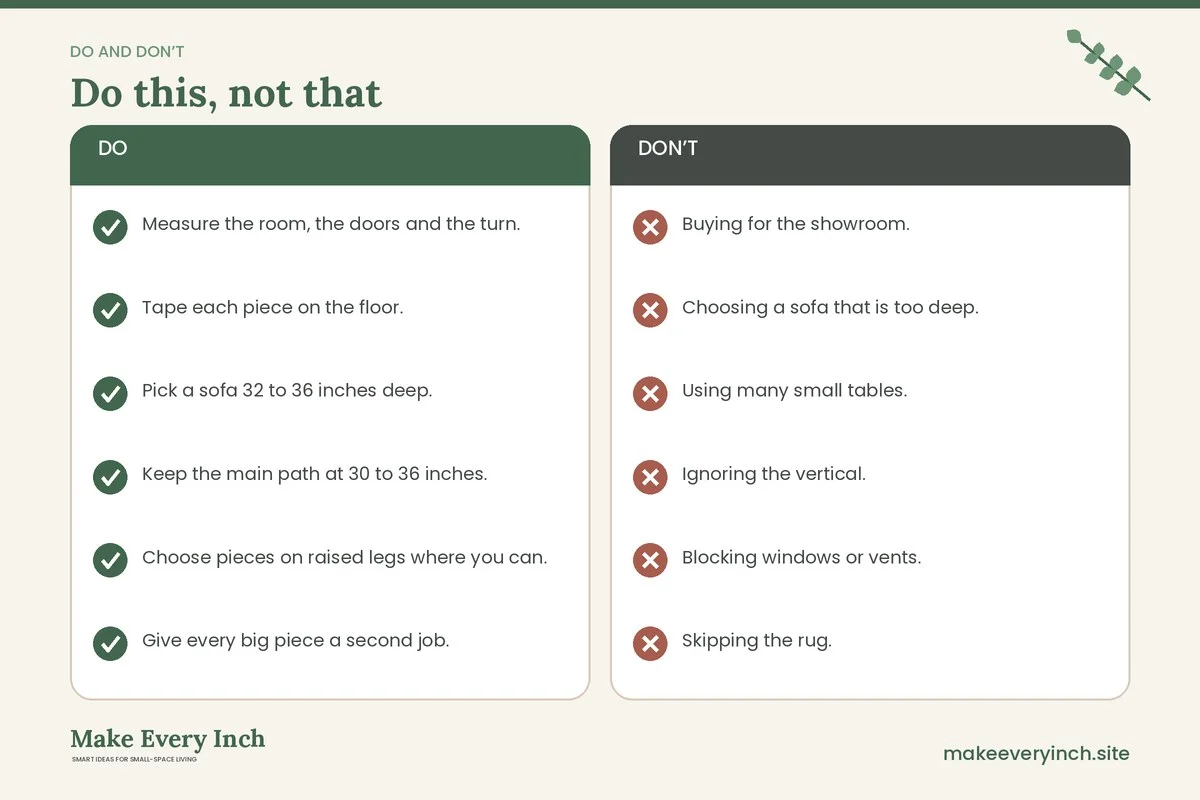
- Buying for the showroom. Check the depth and height at home with tape.
- Choosing a sofa that is too deep. A deep seat feels good but eats floor.
- Using many small tables. One or two good surfaces serve better.
- Ignoring the vertical. A room with only low furniture feels wide but shallow, while a tall narrow bookcase adds storage and height.
- Blocking windows or vents. Tall pieces in front of a window cut the light and make the room feel smaller.
- Skipping the rug. Without a rug, the furniture floats and the room feels unfinished.
- Matching everything. A matching set can read as heavy, so mix two or three materials.
For more on this, read small space furniture mistakes to avoid.
Shopping checklist
- Measure the room, the doors and the turn.
- Tape each piece on the floor.
- Pick a sofa 32 to 36 inches deep.
- Keep the main path at 30 to 36 inches.
- Choose pieces on raised legs where you can.
- Give every big piece a second job.
- Add a 5 by 8 foot rug.
- Choose a media unit 12 to 16 inches deep.
- Anchor tall pieces to the wall, with permission.
- Check weight limits on shelves and fold-downs.
- Keep cords tidy and vents clear.
- Buy in order, and live with each piece for a week.
FAQ
How big should a sofa be in a small living room?
A length of 60 to 78 inches and a depth of 32 to 36 inches suits most rooms under 120 square feet. Measure your own room, since window and door placement change the answer.
Should I buy a sectional for a small living room?
Only if the room is long enough, roughly 11 feet or more, and the delivery path allows it. A sectional uses a corner well, but it can crowd a short room.
Do I need a coffee table?
Not always. Nesting tables, a tray ottoman or two side tables can replace it. If you keep one, round or lift-top versions work best in tight rooms.
What furniture helps storage the most?
A tall narrow bookcase, a storage ottoman and a slim media unit give the most storage for the least floor. See our small living room storage ideas for more.
Can I mix styles?
Yes. Two or three shared elements, such as a color or a leg shape, hold a mixed room together.
How do I choose furniture if I rent?
Pick freestanding pieces, use no-drill solutions for tall units where the lease allows and ask permission before any wall fixing. Our guide to renter friendly furniture ideas for small spaces has more.
Keep going: Keep going with how to make a small living room look bigger, small living room layout ideas and small living room storage ideas.
Save this guide for later
Pin the ideas you like to Pinterest so you can come back to them when you plan your space.