Small Home Office Ideas: The Complete Guide to Working Well in Little Space
Quick answer: The best small home office ideas start with a protected work zone, not a big desk. Pick the spot with the most daylight and the fewest interruptions, choose a slim or wall-mounted desk, light the task and the background separately, store paper and tech vertically, tame the cables and keep the setup easy to close down at the end of the day. Measure first, check the lease before you drill and keep the electrical load sensible.
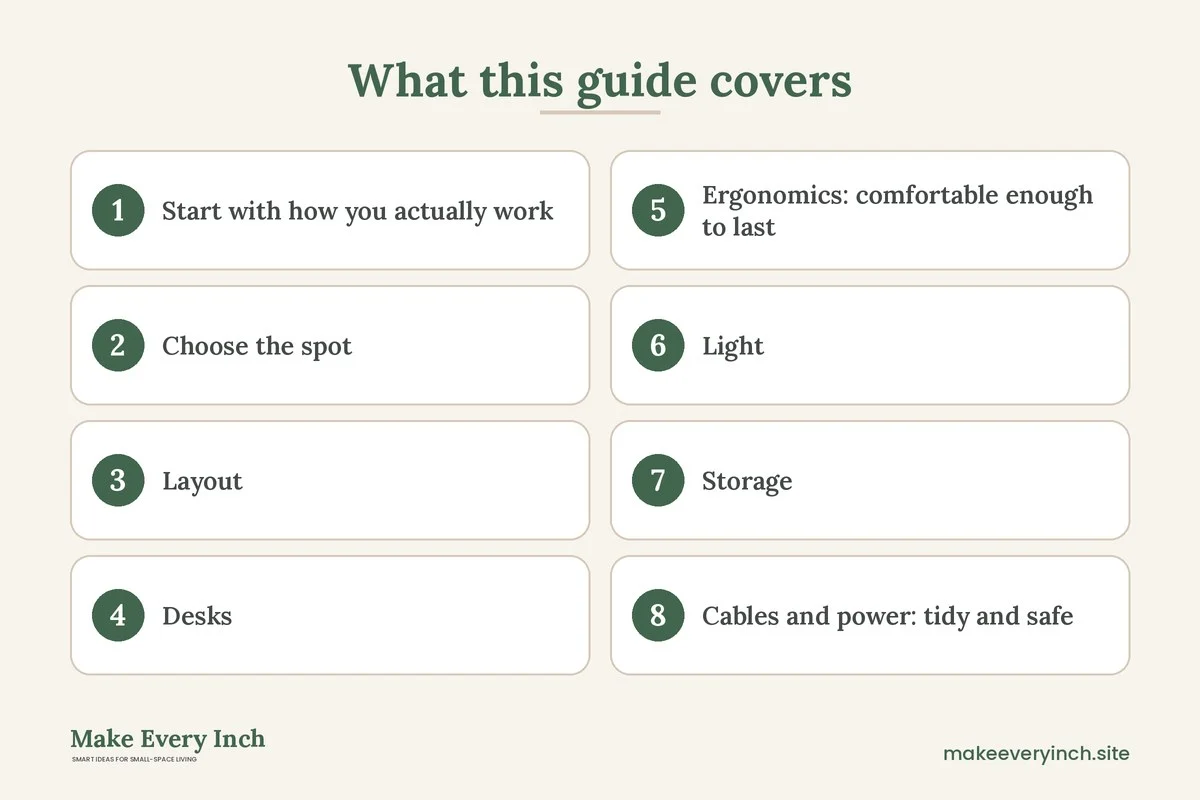
Small home office ideas all start from the same awkward fact: most of us do not have a spare room, yet our work still needs a place to live. The kitchen table is too public, the sofa is too soft and the bed is the one place a working mind should not be. The good news is that a productive office needs far less space than most people imagine. A desk surface about 24 inches deep and 40 to 48 inches wide, a supportive chair, decent light and a way to hide the mess are enough for most jobs. This pillar guide pulls together everything we know about working well in a small home. It covers how to choose a spot, how to plan the layout, desks, storage, lighting, cables, video-call backdrops, color, sharing a workspace and staying safe. Each section links to a detailed guide, and the final section lists every small home office post in one place. If you rent, keep your lease in mind throughout.
Start with how you actually work
Before you buy a single thing, spend a week noticing how your workday really goes. Do you work on a laptop or on two monitors? Do you spend hours on calls, or mostly in quiet focus? Do you handle paper, samples or equipment? Do you work every day, or two days a week? A person who writes on a laptop for three hours needs a very different space from someone who runs back-to-back video meetings or spreads out design work.
Write a short list of what the space must support and rank it. A common list includes a laptop, a monitor, a notebook, a phone charger, a lamp and a drawer for papers. Add anything unusual, such as a printer, a drawing board or a sewing machine. The ranked list tells you how much surface you need, and it stops you from buying a desk that is too large for the room. If your needs are modest, read our guide to small home office ideas that fit anywhere for setups that work in almost any corner.
Next, measure. Draw the room on graph paper or in a free floor planner, and mark windows, doors, radiators, outlets and the swing of every door. Tape the footprint of the desk and chair on the floor with painter’s tape and live with the tape for a day. Sit in the taped chair, push it back as you would to stand up, and check that you are not blocking a path. Tape costs nothing and prevents most expensive mistakes.
Choose the spot: where a small office can live
The best location is usually the one with the most natural light, the least foot traffic and a wall behind the desk. Daylight from the side is ideal, because it avoids glare on a screen and shadows on your hands. Light from directly behind the screen causes glare, and a window behind you can wash out a video-call image. If you have a choice, face a wall or turn the desk so the window is to your left or right.
Work through the common options below and weigh them against your home. None is perfect, and each has trade-offs that the linked guides explain in detail.
A corner of the bedroom
The bedroom is the most common home for a small office, because it often has a spare wall and a door that closes. The danger is that work follows you into bed and sleep follows you into work. A divider, a rug, a different light color and a rule that the laptop closes at a set time all help. See our guide to small home office ideas in a bedroom and our companion post on small bedroom ideas with a desk for plans that keep the two zones apart.
A closet
A closet office, sometimes called a cloffice, borrows a wardrobe or a coat closet and turns it into a tiny workroom. It has natural boundaries and doors that close on the mess. It also has ventilation and lighting limits, so you need to plan for air, power and a task lamp. Read small home office ideas in a closet before you start, and see our wider pillar on small closet ideas for ways to free up the space.
The living room
If the living room is your only public space, the office has to share it. A desk behind the sofa, a console that doubles as a workstation or a fold-down surface on a wall can all work. The aim is to be able to hide work at the end of the day. See small home office ideas in a living room and the pillar on small living room ideas for layouts that keep both functions.
A home with no spare room
Sometimes there is no corner, no closet and no door to spare. Then the answer is a work zone made of furniture, light and habit rather than walls. Our guide to small home office ideas with no spare room and the post on how to create a work zone in a small apartment show how to claim a workspace in a hallway, a landing, a dining nook or the end of a room.
A studio
A studio asks one room to be a bedroom, a living room and an office, which makes zoning essential. Our guide to studio apartment ideas for working from home and the post on how to fit a desk into a studio apartment cover the most successful plans, and the hub on studio apartment ideas shows how the work zone fits into the bigger picture.
Layout: arrange the room around the work
A good layout is mostly about clearances. Allow about 36 inches behind the desk chair so you can stand and sit without bumping into something, and leave a path of at least 30 inches to the door. If the desk sits against a wall, keep 24 inches or more to one side so you can reach the outlet and sit down without squeezing. Put the monitor at roughly an arm’s length from your eyes, and keep the keyboard and mouse close enough that your elbows can rest near your sides.
Position the desk so that you can see the door, or at least the room, if possible. Many people find it more comfortable to face the room than to work with their back to a doorway. Place a lamp on the side opposite your writing hand to avoid shadows. If you sit near a window, a sheer curtain softens glare without cutting daylight.
In very small rooms, the layout rests on three decisions: which wall the desk takes, whether it faces the wall or the room, and how the chair tucks away. A desk against the long wall with the chair tucked under uses the least floor. A desk at a window with a slim profile gives light but may need a screen to control glare. A corner desk uses wasted space but can feel boxed in. Our guide to small home office layout ideas includes plans for square, narrow and awkward rooms, with measurements for each.
Desks: the biggest decision in a small office
The desk is the biggest object in the office and sets the pattern for the rest. For a laptop user, a surface 20 to 24 inches deep and 36 to 48 inches wide is usually enough. For a monitor and a notebook, aim for 24 to 30 inches in depth. Anything wider than 55 inches in a small room is usually a luxury.
Slim and standard desks
A slim desk fits in a hallway, behind a sofa or along a wall. A console table, a narrow writing desk or a small dining table can all do the job. Look for a sturdy top, a lower shelf for a printer or a basket and legs that leave room for your knees. See small home office desk ideas for sizes and layouts, and our guide to the best desks for small apartments for the features to look for when you shop.
Wall-mounted and fold-down desks
A wall-mounted desk gives you a work surface that disappears when you finish. It frees the floor, suits small rooms and works well in a nook. It also asks for careful installation, because a desk loaded with a monitor and elbows takes more force than a shelf. Use fixings rated for the load and the wall type, fasten into studs or use proper anchors for the wall material, and check the lease before drilling. Our post on small home office ideas with wall-mounted desks explains how to choose and fit one safely.
No desk at all
You can also work without a desk. A lap tray, a console, a kitchen counter, a window ledge or a bookshelf shelf at the right height can all become a work surface. This approach suits people who work for short bursts or who need to put everything away. See small home office ideas without a desk for options that suit different jobs, and remember that a very low surface is a poor choice for long hours.
Build your own
A homemade desk can be cheap and fit a strange space exactly. A board across two filing cabinets, a door on trestles or a shelf on brackets are all familiar options. Our guide to DIY desk ideas for small spaces covers plans and the weight limits you should respect.
Ergonomics: comfortable enough to last
Comfort matters more in a small space, because you cannot move around much. These pointers are general guidance, not medical advice. If you have pain, an injury or a health condition, talk to a qualified professional about your setup.
- Chair: choose a chair that supports your lower back and lets your feet rest on the floor or on a footrest. A dining chair with a cushion can be a short-term fix, but a supportive chair is worth the space for long days.
- Screen height: many people find it comfortable when the top of the screen sits near eye level, so the neck stays fairly neutral. A stand or a stack of books can raise a laptop, with a separate keyboard and mouse.
- Arms and wrists: keep forearms roughly level with the desk and wrists fairly straight. Avoid resting the wrists on a hard desk edge.
- Breaks: stand, stretch and look into the distance now and then. A short timer can remind you.
- Surfaces: keep frequently used items within easy reach, so you do not twist or stretch.
Because bodies differ, adjust these ideas to fit you. A setup that looks right on paper may feel wrong after an hour, so trust discomfort as a signal to change something.
Light: the quiet hero of a small office
Good lighting makes a small office feel larger and protects your eyes. Plan three layers: ambient light for the room, task light for the desk and a soft accent for the background. A single overhead light is rarely enough, because it can cast shadows on the work and leave the corners dark.
Use daylight when you can, and place the desk so the window is at the side. Add a task lamp with an adjustable arm, and place it on the side opposite your writing hand. A warm-to-neutral color temperature suits most people during the day, and a dimmable lamp helps at dusk. For video calls, a soft light in front of your face works better than a lamp behind you. Our guide to small home office lighting ideas goes through bulbs, lamp types and layouts, and the post on small home office ideas for video calls shows how to light your face and tidy the view behind you.
Storage: make the walls and the desk work
A small office stays calm only if everything has a home. The rule of thumb is to store vertically, keep the desk clear and put things you use daily within reach. Daily items include a notebook, pens and a charger. Weekly items can go in a drawer or a box. Monthly or yearly items, such as tax papers and manuals, can go in a labeled box elsewhere.
- Wall shelves above the desk hold books and files without taking floor space.
- A pegboard or a rail holds scissors, tape and cords.
- A slim rolling cart tucks under the desk and holds paper and supplies.
- A filing box with a lid hides paper on a shelf or in a closet.
- Drawer dividers keep small items from piling on the surface.
- Baskets on a shelf hide cables, chargers and spare tech.
See small home office storage ideas for more, and our pillar on small space organization ideas for general systems you can borrow. When you want to check that your system works, run through our small home office organization checklist once a month.
Cables and power: tidy and safe
Cables are the thing that makes a small office look messy. A laptop, a monitor, a lamp, a phone charger and a router can produce a nest of wires within a week. Tidy cables look better, and they also reduce the chance of tripping or damaging a plug.
Start by unplugging everything and labeling each cord. Use clips to hold cords along the back of the desk, a sleeve or a box to gather the rest, and a cord cover on any section that crosses a floor. Keep power cords away from foot traffic. If you rent, choose adhesive clips and covers that remove cleanly, and read our guide to renter-friendly ways to hide cords. For more office-specific plans, see small home office cable management ideas.
Respect the electrical load
Small offices tend to pack many devices onto one outlet. A power strip is not a way to add capacity, and it has a limit. Do not daisy-chain power strips, do not run a space heater, a kettle or a similar high-draw appliance from the same strip as your computer and do not cover strips or adapters with fabric or boxes. Add up the devices on any strip and compare them to the rating printed on the strip and the circuit. If a plug feels hot, a strip smells of burning or a breaker trips often, stop and have the wiring checked by a qualified electrician. Surge protection is useful, but it is not a license to overload a circuit.
Color and mood
Color changes how a small office feels. Light, soft colors reflect daylight and make a space feel open. Deeper tones can make a small corner feel cozy and focused. Most people choose a calm base, one accent color and natural materials such as wood and plants. Avoid too many patterns on the wall behind the desk if you take video calls, because a busy background distracts viewers.
If you rent, use removable options such as peel-and-stick panels, fabric, art on a shelf or a painted board. Check your lease before you paint. Our guide to small home office color schemes walks through palettes for different light levels and moods.
Sharing a space
Some small offices serve more than one person or more than one use. Couples working side by side, a student and a parent sharing a table, or a work zone in a family living room all call for more planning.
Two people
When two people work in the same small room, the problems are noise, glare and cables. Place desks so screens do not face each other, give each person a lamp and a drawer, and use headphones. A wide shared desk is often better than two small ones. See small home office ideas for two people for plans that give both people room.
Shared spaces
A work zone in a shared room needs boundaries. A rug, a shelf, a screen or a different light can mark where work starts and stops. A rule for quiet hours helps too. See small home office ideas for shared spaces.
Students
Students often need a spot for study, a laptop and a pile of books, in a room that is also a bedroom. A fold-down desk, a lap tray with a good lamp and a simple filing system work well. See small home office ideas for students for study-friendly plans.
Make a bedroom or living room less cramped
Two larger pillars are worth reading if your office sits in a main room. Our guide to small bedroom ideas shows how to arrange a bed, storage and a desk in the same room, and our pillar on small living room ideas covers layout, seating and storage. If budget is a limit, the hub on budget small space ideas pulls together low-cost fixes. Cheap fixes can be as good as expensive ones if they fit the space and the way you work.
Choosing a setup: a comparison table
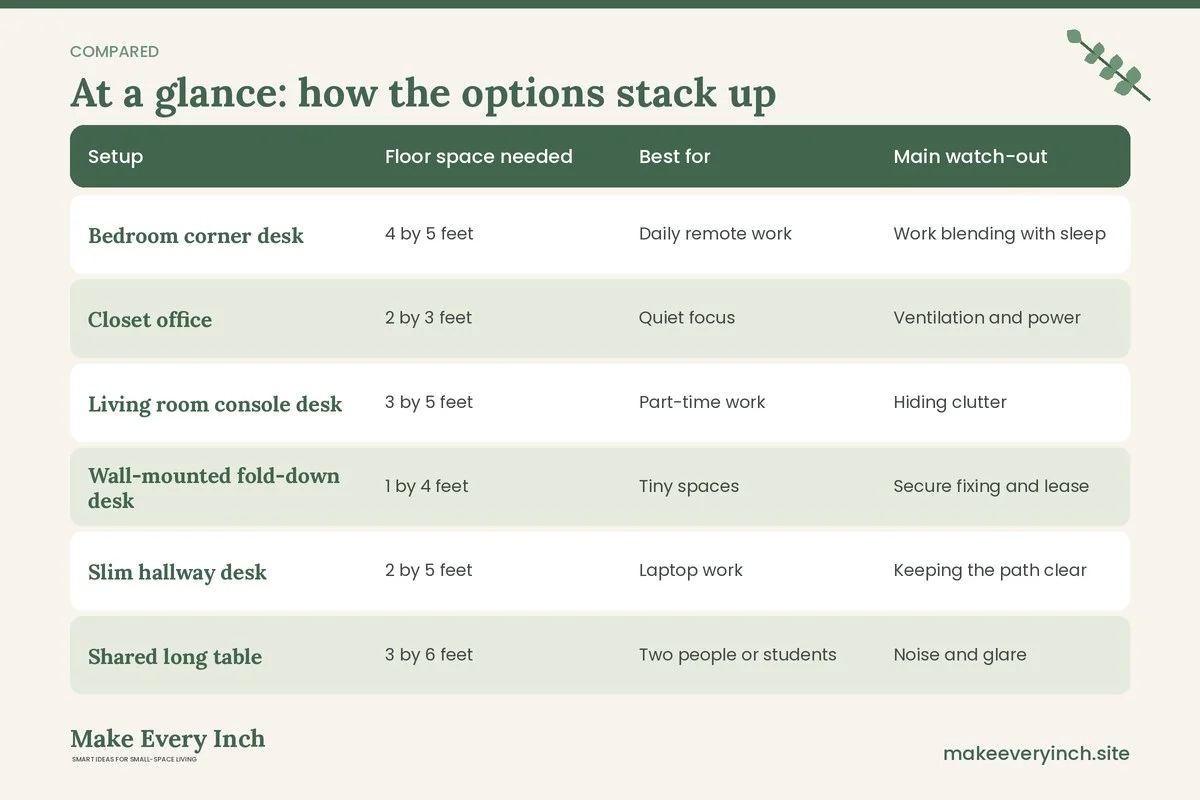
The table below compares the most common small office setups. Use it as a quick filter before you shop, and read the linked guide for each option.
| Setup | Floor space needed | Best for | Main watch-out |
|---|---|---|---|
| Bedroom corner desk | 4 by 5 feet | Daily remote work | Work blending with sleep |
| Closet office | 2 by 3 feet | Quiet focus | Ventilation and power |
| Living room console desk | 3 by 5 feet | Part-time work | Hiding clutter |
| Wall-mounted fold-down desk | 1 by 4 feet | Tiny spaces | Secure fixing and lease |
| Slim hallway desk | 2 by 5 feet | Laptop work | Keeping the path clear |
| Shared long table | 3 by 6 feet | Two people or students | Noise and glare |
| Lap tray and console | Very little | Short sessions | Posture over long hours |
Common mistakes to avoid
Most small office problems come from a few repeat errors. Buying a desk before measuring, ignoring light, leaving cables loose, using the bed as a seat and forgetting storage are the usual ones. Another mistake is sacrificing a good chair to save space. Our post on small home office mistakes to avoid goes through them, with fixes for each.
Safety, anchoring and the lease
Four safety points deserve their own section.
- Anchoring: tall shelves, bookcases and monitors on stands can tip. Anchor tall furniture to the wall using the right hardware for your wall type, and keep heavy items low. A wall-mounted desk must be fixed to studs or proper anchors rated for the load.
- Electrical load: do not overload outlets, avoid daisy-chaining power strips and keep cords out of walkways. If in doubt, ask a qualified electrician.
- Lease permission: many leases limit drilling, painting and fixed installations. Ask in writing before you drill, and choose freestanding or adhesive options when you cannot get permission. Photograph the wall before and after.
- Ergonomics: the pointers in this guide are general and not medical advice. Listen to your body and seek professional advice for pain.
Also keep exits clear. A desk or a shelf should never block a door, a window you might need in an emergency or access to a smoke alarm.
A simple checklist for your small home office
Use this list to plan, build and maintain your space.
- Write down how you work and what you need on the desk.
- Pick the spot with the most daylight and the fewest interruptions.
- Measure the room and tape the desk and chair footprint.
- Keep 30 inches for paths and about 36 inches behind the chair.
- Choose a desk that fits the job, not the largest one that fits the room.
- Add a task lamp and soften glare from windows.
- Store paper and tech vertically, with a home for every item.
- Gather cables, label them and keep them out of walkways.
- Check power strip ratings and avoid daisy-chaining.
- Anchor tall furniture and wall desks properly.
- Ask the landlord before drilling or painting.
- Set a clear end-of-day routine that closes the office.
- Review the setup monthly and adjust.
Frequently asked questions
How much space do I need for a small home office?
Many people work comfortably in a footprint of about 4 by 5 feet, including the chair. A tiny closet or a wall-mounted desk can work in less, but you need to allow room to sit down and stand up. Tape the footprint on the floor to test it before you buy.
What is the best place for a home office in a small home?
The best place has daylight, a wall behind the desk and little foot traffic. For many homes that is a bedroom corner, a spot behind the sofa or a closet. The right choice depends on whether you take calls, how long you work and who else lives with you.
Can I make a home office without a desk?
Yes. A console, a counter, a wall shelf or a lap tray can serve as a work surface. This is best for short sessions. For long days, a proper desk and chair are usually more comfortable.
How do I keep work and home life apart in a small space?
Create a visible boundary with a rug, a screen or a shelf, and use a different light for work. Put the laptop away at a set time, and cover or hide the desk if you can. A closing routine tells your mind that the day is over.
How can I make a small office look good on video calls?
Face a soft light source, keep the background simple and place the camera at about eye level. A tidy shelf or a plain wall works better than a busy room. See our guide to small home office ideas for video calls for more.
Is it safe to mount a desk on the wall?
It can be safe if the fixings match the load and the wall type, and if you fasten into studs or use rated anchors. Many rentals do not allow it, so check the lease first. If you are unsure, ask a qualified installer or choose a freestanding desk.
How do I hide cables in a rental?
Use adhesive clips, cord covers and a box or sleeve that remove cleanly. Route cords along furniture rather than walls, and keep them away from walkways. Avoid anything that needs nails or screws unless the lease allows it.
How can I set up a small office on a budget?
Start with what you have: a table, a shelf and a lamp. Add a chair that supports you, then add storage and light as you can. Secondhand furniture and DIY desks can work well. See our pillar on budget small space ideas for more.
All our small home office guides
Every guide in this cluster is listed below. Pick the one that matches your space or your question.
- Small home office ideas in a bedroom: how to carve out a work corner without ruining your sleep.
- Small home office ideas in a closet: turn a wardrobe or a coat closet into a tiny workroom.
- Small home office desk ideas: slim, corner and compact desks for tight rooms.
- Small home office ideas that fit anywhere: flexible setups for any corner of a home.
- Small home office layout ideas: plans and clearances for square, narrow and awkward rooms.
- Small home office ideas in a living room: share a main room without losing either function.
- Small home office ideas without a desk: work surfaces that use a console, a shelf or a tray.
- Small home office lighting ideas: layer daylight, task light and accents.
- Small home office storage ideas: vertical storage that clears the desk.
- Small home office ideas for two people: plans for couples and housemates who work side by side.
- Small home office cable management ideas: tame cords and keep them safe.
- Small home office organization checklist: a monthly list to keep the space under control.
- Small home office ideas with no spare room: claim a work zone when you have no free room.
- Small home office color schemes: palettes for light, mood and video calls.
- Small home office mistakes to avoid: the common errors and how to fix them.
- Small home office ideas for shared spaces: set boundaries in a room that serves many uses.
- Small home office ideas for students: study-friendly setups for small rooms.
- Small home office ideas for video calls: lighting, framing and backgrounds that look tidy.
- Small home office ideas with wall-mounted desks: fold-down and fixed desks that free the floor.
- How to create a work zone in a small apartment: mark out a workspace with furniture, light and habit.
Keep going: Keep going with small home office desk ideas, small home office layout ideas and small home office storage ideas.
Save this guide for later
Pin the ideas you like to Pinterest so you can come back to them when you plan your space.