Small Home Storage Ideas for Every Room
Quick answer: Small home storage ideas for every room work best when you inventory what each room must hold, then match storage to it. Give the entry a landing strip, the living room closed storage at seat level, the kitchen vertical and drawer storage, the bedroom under-bed and wardrobe tiers, the bath wall and over-door storage, and the laundry a shelf plus a hamper system. Measure first, borrow space between rooms only on purpose, and anchor tall furniture.
Small home storage ideas for every room start with a list, not a shopping cart. Most storage advice jumps to products, but a small home is a puzzle of what must be stored and where there is room for it. If you know what each room has to hold, the right shelf, hook or box becomes obvious. This guide walks through the home room by room: the entry, the living room, the kitchen, the bedroom, the bathroom and the laundry area. For each room you will find an inventory prompt, measurements to plan around, storage ideas ranked from easy to ambitious, and a mistake to avoid. A comparison table, three example homes, a checklist and an FAQ finish the guide. For the wider approach, read our main guide to small space organization ideas, and for the habits that keep storage working, see the companion post on small home organization ideas that actually last.
Start with a whole-home storage inventory
Before you look at any single room, take a short walk through the home with a notebook. For each room, write three lists. The first is what the room needs to store because it is used there, such as shoes at the entry and towels in the bath. The second is what is stored there only because there was space. The third is what is missing a home and ends up on a surface. The second list is your first source of room, because those items can move. The third list tells you what to design for.
Measure the storage you already have
Most homes have more storage than people realize, and it is often poorly used. Measure the following and write the numbers down.
- Closet rail length and depth: a standard hanging rail needs about 24 inches of depth for hangers to sit without crushing clothes.
- Shelf depth and spacing: note each shelf’s depth and the gap above it. Wasted headroom above shelves is common.
- Drawer interiors: width, depth and height. Divider choices depend on these.
- Wall and door clear space: note blank stretches of wall, the back of each door and the space above doors.
- Under furniture clearance: measure from the floor to the bottom of the bed, the sofa and the console. Under-bed clearance is often in the range of 6 to 18 inches.
- Ceiling height: useful for deciding how high shelves can go. Keep frequently used items between knee and shoulder height.
Sort rooms by pressure
Rank the rooms from most to least pressure. The room that has the most things on its surfaces is your priority. In many small homes the entry, the kitchen and the bedroom come first, but your ranking may differ. Start where the pressure is highest, and the rest of the home will feel lighter as items find their way back to their rooms.
Borrow space deliberately
Rooms can lend storage to each other. Off-season bedding might sit on a high shelf in the hallway closet, and the bathroom may borrow a cabinet from the bedroom for spare towels. The rule is to lend on purpose, with a label and a note in your inventory, not by accident. Borrowed storage that is not recorded turns into clutter nobody can find.
The room-by-room comparison
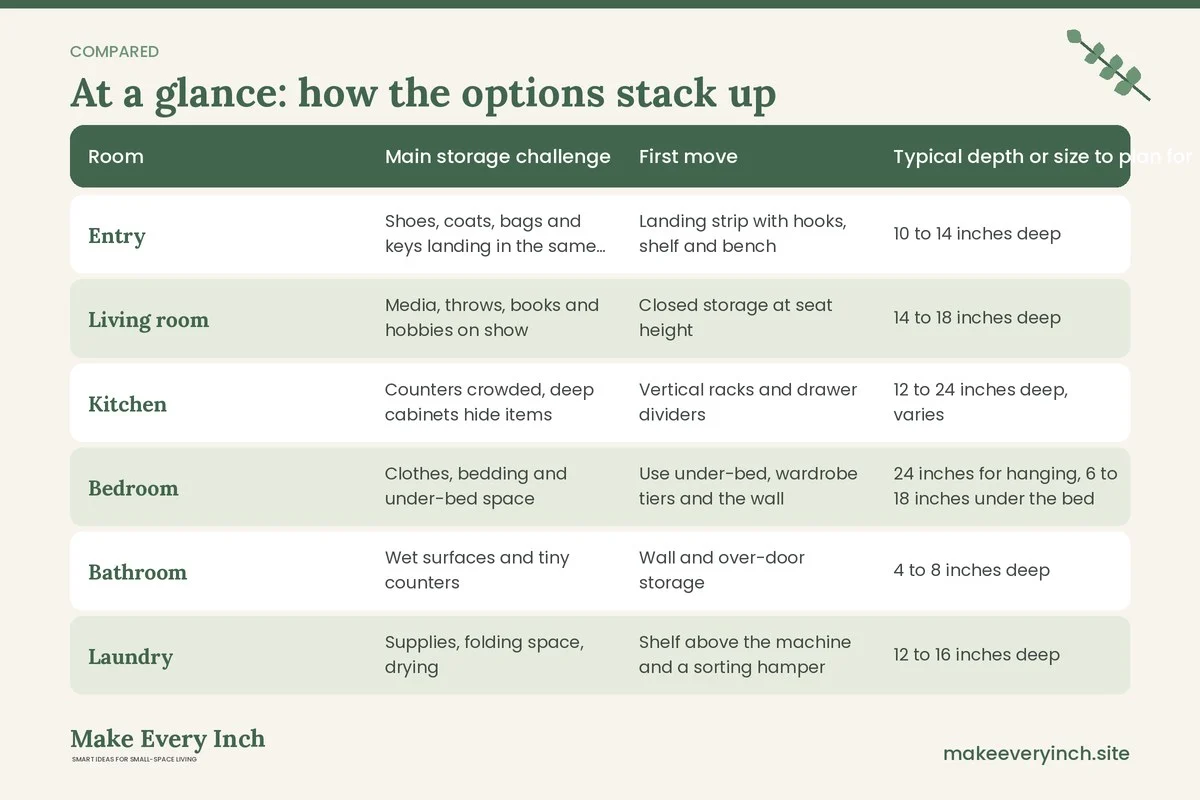
The table below summarizes the main storage move for each room, the typical constraint and the first thing to try.
| Room | Main storage challenge | First move | Typical depth or size to plan for |
|---|---|---|---|
| Entry | Shoes, coats, bags and keys landing in the same spot | Landing strip with hooks, shelf and bench | 10 to 14 inches deep |
| Living room | Media, throws, books and hobbies on show | Closed storage at seat height | 14 to 18 inches deep |
| Kitchen | Counters crowded, deep cabinets hide items | Vertical racks and drawer dividers | 12 to 24 inches deep, varies |
| Bedroom | Clothes, bedding and under-bed space | Use under-bed, wardrobe tiers and the wall | 24 inches for hanging, 6 to 18 inches under the bed |
| Bathroom | Wet surfaces and tiny counters | Wall and over-door storage | 4 to 8 inches deep |
| Laundry | Supplies, folding space, drying | Shelf above the machine and a sorting hamper | 12 to 16 inches deep |
Use these numbers as a starting range, then measure your own spaces.
Entry storage
The entry has the highest traffic and the smallest footprint, so it benefits most from clear rules. People arrive here carrying shoes, bags, keys, mail, umbrellas and packages, and everything wants to land at once.
Inventory prompt
List what each person brings in daily and what leaves with them. Add seasonal items such as hats, gloves and umbrellas. Limit shoes to what fits in the space, and store the rest elsewhere.
Entry storage ideas
- A landing strip: a short shelf or narrow console, 8 to 12 inches deep, with a tray for keys and a basket for mail. Keep it to a single surface so it does not become another dumping ground.
- Hooks at two heights: a row of hooks at about 60 to 66 inches for adults and a second row lower for children and bags. Hooks are faster than hangers for daily use.
- A shoe solution: a narrow cabinet with tilted shelves, or a slim rack. See our guides to small shoe storage ideas and the best narrow shoe cabinets.
- A bench with a lid: a seat with storage beneath it for gloves, hats and bags. Pick one with a lid that does not slam.
- Over-door storage: a rack on the back of the entry door. Check that the door still closes properly and that the rack fits your door’s thickness.
- A mirror that doubles as storage: a mirror with a shelf or hooks attached, which saves wall space.
For more ideas, read our guides to small entryway storage, small entryway organization and tiny foyer ideas. If your home has no real entry, see no-entryway apartment ideas.
Mistake to avoid
Do not overfill the entry with decor. A small entry works best when it is a working zone with one decorative item at most.
Living room storage
The living room stores a surprising amount: media, throws, books, games, hobbies and often a laptop and paperwork. Because it is the main shared space, storage here should look calm.
Inventory prompt
List what is used in the room daily and what has drifted in. Decide what the room should hold: remotes, a few books, throws, perhaps a game. Move the rest.
Living room storage ideas
- Closed storage at seat height: a low cabinet or a sideboard, 14 to 18 inches deep, hides cables, games and papers. Closed doors reduce visual noise.
- A storage ottoman or bench: a seat that holds blankets and remotes. See the best storage ottomans.
- Narrow bookshelves: a tall, slim unit uses vertical space. See the best narrow bookshelves, and anchor it to the wall to prevent tipping.
- A console behind the sofa: a surface 10 to 14 inches deep that holds lamps, a tray and baskets.
- Wall storage: floating shelves or a ledge for books and small items. Ask permission before drilling, or choose freestanding options.
- TV storage: a slim media unit with doors, or a wall-mounted TV with a shelf for the router. Make sure vents have clearance, and do not enclose heat-producing devices in a sealed box.
- Under-furniture space: a shallow tray or box under the sofa, if the clearance allows.
For many more ideas, see our guides to small living room storage ideas and small apartment living room ideas with storage. For furniture that stores, read our guide to small space storage furniture.
Mistake to avoid
Do not pick open shelving for everything. Open shelves reward editing, and in a living room that is used daily, they can become busy quickly. Mix open and closed storage in a ratio you can maintain.
Kitchen storage
The kitchen packs the most things into the least space, from food to small appliances to tools. Storage here has to be efficient and hygienic.
Inventory prompt
List what you cook with weekly, what you cook with monthly and what you keep but rarely use. The weekly list gets prime space. The rarely used list moves to the hard zone, or leaves.
Kitchen storage ideas
- Drawer dividers: dividers keep utensils, wraps and gadgets in their places. See our guide to small kitchen drawer organization ideas.
- Cabinet risers and shelf inserts: a shelf riser adds a level in a cabinet with wasted headroom. Measure the interior height before buying.
- Pull-out organizers: these suit deep base cabinets. Choose ones that fit the opening and the hinge swing. Read our guide to small kitchen cabinet organization ideas.
- Wall storage: a rail with hooks, a magnetic strip for knives kept safely out of reach of children, and a shelf above the counter. See small kitchen wall storage ideas.
- Pantry zones: a pantry cupboard, a shelf or a cart. See small kitchen pantry ideas, and for homes without one, small kitchen ideas with no pantry.
- A rolling cart: adds a shelf and a work surface. See the best rolling kitchen carts.
- Counter discipline: keep only what you use daily on the counter. For more, see small kitchen counter organization.
For the full picture, read our guide to small kitchen organization ideas and small kitchen storage ideas.
Safety note
Keep heavy items low, keep knives and cleaning products out of reach of children, and do not store items on top of the fridge where heat can be an issue. Do not block the stove area or vents with storage, and keep towels and paper away from burners.
Mistake to avoid
Do not fill every inch. Packed cabinets slow cooking, because you spend time moving things to reach the one you want.
Bedroom storage
The bedroom must hold clothes, bedding, shoes and often a desk or hobby gear. The bed is the biggest piece of furniture, so make it work.
Inventory prompt
Separate clothes into daily, seasonal and occasional. Add bedding, luggage, extra towels and keepsakes. The daily clothes belong in the easy zone, while the rest can move higher or lower.
Bedroom storage ideas
- Under-bed storage: shallow boxes with wheels or lids use space that is otherwise lost. See under-bed storage ideas, and keep dust out with lidded boxes.
- A bed with storage: drawers or a lift-up frame. See the best beds with storage.
- A dresser that fits: choose a depth that does not block the walkway. See the best small dressers.
- Wardrobe tiers: a double rail, shelf dividers and slim hangers raise capacity. Our guide to small closet organization ideas covers this in depth.
- No closet? Use a freestanding wardrobe or a rail. See small bedroom ideas without a closet.
- Wall and door storage: hooks, over-door racks and floating shelves. Ask permission before drilling.
- Bedside storage: a narrow table or a wall-mounted shelf, kept to things used nightly.
- Headboard storage: a headboard with a shelf holds a book and a light, but check that it is stable.
For more, read our guides to small bedroom storage ideas, small bedroom storage ideas that save floor space and small bedroom organization ideas.
Safety note
Anchor tall dressers and wardrobes to the wall using the supplied hardware, particularly if children live in the home. Leave a clear path from the bed to the door.
Mistake to avoid
Do not store everything under the bed. Under-bed space is hard to reach, so keep only off-season or occasional items there.
Bathroom storage
The bathroom is small, damp and full of tiny items. Storage must resist moisture and make use of the walls.
Inventory prompt
List the products used daily, weekly and rarely. Check expiry dates, and remove duplicates. The daily products stay close, and the rest go to a box or a cabinet elsewhere.
Bathroom storage ideas
- Over-the-toilet storage: a shelf or cabinet over the toilet. See the best over-the-toilet storage.
- Wall shelves: narrow shelves for towels and baskets. See small bathroom shelving ideas.
- Vanity storage: drawer dividers and under-sink organizers. Keep room for the plumbing. See small bathroom vanity ideas.
- Over-door hooks: towels and robes without drilling.
- Shower storage: caddies and corner shelves made for wet areas. Pick rust-resistant types and clean them regularly.
- A towel plan: two towels per person is a common starting point; roll or fold them to fit a shelf or basket.
- Hidden storage: a mirrored cabinet or a recessed niche if renovating. See hidden storage ideas.
For more, read our guides to small bathroom organization ideas and tiny bathroom storage ideas. If you rent, read renter-friendly bathroom ideas.
Safety note
Keep medicines and cleaning products out of reach of children. Keep electrical items such as hairdryers and razors away from water, and do not place a plug-in item where it can fall into the sink or bath. Ventilate the room well to prevent mold.
Mistake to avoid
Do not crowd the shower and the counter. Too many bottles slow cleaning and invite mold.
Laundry storage
Laundry might be a closet, a corner of the bathroom or a shared room. It needs space for supplies, sorting and drying.
Inventory prompt
List supplies, the number of loads per week and how you dry clothes. If you share machines, add a carry bag.
Laundry storage ideas
- A shelf above the machine: holds detergent and supplies. Keep it at a height you can reach, and secure it to the wall properly.
- A sorting hamper: two or three compartments reduce sorting time.
- Slim cart between machines: a rolling cart in a gap of 6 to 10 inches. Check that it does not block vents or hoses.
- Drying space: a folding rack, a tension rod or a wall-mounted drying rack.
- Cleaning supplies: a rack on the door for brooms and mops.
- Folding surface: a board that sits over a machine or a fold-down shelf.
For more, see our guide to small laundry room organization.
Safety note
Keep the dryer vent clear, clean the lint trap after each use and do not stack items on top of a running dryer. Store detergents and other chemicals away from children and pets. Do not block the machine’s ventilation.
Mistake to avoid
Do not turn the laundry area into a storage dump. Keep it for laundry, and let other items go to their own rooms.
Three example homes
A studio of about 400 square feet
The studio’s pressure points are the entry and the bed. At the entry, a 10-inch deep shelf with three hooks above it takes bags and keys. A row of lidded under-bed boxes holds off-season clothes, with a note in the inventory. The kitchen gets drawer dividers and a magnetic strip. A tall bookshelf separates the bed from the living area, anchored to the wall. The bathroom uses an over-door rack and a wall shelf. The laundry is a shared one, so a folding bag goes on a hook by the door. This studio uses every room’s storage lightly, instead of cramming a single closet.
A one-bedroom apartment of about 650 square feet
The one-bedroom has a small hall closet, a galley kitchen and a bedroom with a standard closet. The hall closet takes coats, a vacuum and bags, with a shoe rack inside the door. The living room gets a sideboard for games and papers. The kitchen has a rolling cart for the pantry overflow. In the bedroom, a double rail raises the closet’s capacity, and a bed frame with drawers holds linens. The bathroom uses a narrow shelf over the toilet. With these changes, items return to the rooms they belong in, and the surfaces stay clear.
A two-bedroom home for a family of three
Here the volume is the problem. The entry has a bench with cubbies, one for each family member, which cuts the shoe pile. The living room uses a closed cabinet for toys and a storage ottoman for blankets. In the kitchen, a pull-out pantry and a hook rail hold the tools. The child’s room uses under-bed drawers and a toy limit. The bathroom has an over-door rack for towels, and the laundry corner uses a three-section hamper. Each family member has a labeled basket for items waiting to be put away.
Storage across rooms: shared rules
Some rules apply to every room. They also stop the borrowing between rooms from becoming chaos.
- Heavy low, light high. Place heavy items below shoulder height, which is safer and easier to reach.
- Daily items in the easy zone. Between knee and shoulder height, in front.
- One category, one home. Avoid splitting a category between rooms unless you note it.
- Measure, then buy. Container sizes vary, and a mismatch wastes money and space.
- Label shared storage. Labels help roommates, family members and visitors.
- Anchor tall furniture. Bookcases, dressers and wardrobes should be fixed to the wall with the supplied hardware, and ask permission before drilling in a rental.
- Respect weight limits. Shelves, hooks and racks have limits, so follow the packaging.
- Keep exits and vents clear. Do not block doors, heaters, vents or electrical panels.
- Use low-VOC paint if you refinish shelves or cupboards, and ventilate while working.
Budget approach
You do not need to equip every room at once. Start with the room under the most pressure, and use what you have first, such as baskets, jars and boxes. Second-hand shops, online marketplaces and hand-me-downs often have small cabinets, crates and shelves. Spend on items used daily, such as drawer dividers and hooks, and save on items used seasonally. For cost-conscious ideas, read our guide to cheap storage ideas for apartments and budget small space ideas. If you rent, our guide to organization ideas for renters shows what to do without drilling.
Whole-home storage checklist
- Walk the home and write three lists per room.
- Measure rails, shelves, drawers, doors and clearances.
- Rank rooms by pressure and start with the highest.
- Decide what each room should hold.
- Move items that live in the wrong room.
- Record any borrowed storage.
- Set up a landing strip at the entry.
- Add closed storage at seat height in the living room.
- Add drawer dividers and vertical racks in the kitchen.
- Use under-bed and wardrobe tiers in the bedroom.
- Add wall and over-door storage in the bath.
- Add a shelf and a hamper system in the laundry.
- Anchor tall furniture and check weight limits.
- Keep vents, exits and walkways clear.
- Label shared storage.
- Review one room each month.
FAQ
Which room should I organize first?
Start with the room under the most pressure, usually the one with the most clutter on its surfaces. Many people begin with the entry or the kitchen, because they affect daily routines.
How do I add storage without drilling?
Use freestanding shelves, over-door racks, tension rods, adhesive hooks within their weight limits and furniture that stores. Check the lease and avoid anything that could damage the walls.
How much storage does a small home need?
It depends on how many people live there and what they own. Rather than aiming for a number, use the inventory to match storage to what each room needs to hold.
Is it better to use closed or open storage?
Use open storage for daily items you want to see and closed storage for everything else. A mix usually gives the best result.
Where can I store off-season items?
Under the bed, on high shelves, in the top of a closet or in a hallway cupboard. Label boxes and record where they are.
How do I stop storage from becoming clutter?
Set a limit for each space, and review one room every month. Our guide to small home organization ideas that actually last explains how.
Is it safe to stack storage boxes?
Stack lightweight boxes only a few high, keep heavy ones low and make sure the stack is stable. Do not stack in a way that blocks exits or vents.
Keep going: Keep going with our guides to small bedroom organization ideas, vertical storage ideas and small apartment decluttering ideas.
Save this guide for later
Pin the ideas you like to Pinterest so you can come back to them when you plan your space.